Category: Article

  • Scene #2: Maz Kanata gives Chewbacca a medal

    Scene #2: Maz Kanata gives Chewbacca a medal

    Part 2 of 43 Individual Scenes from ‘Rise of Skywalker’

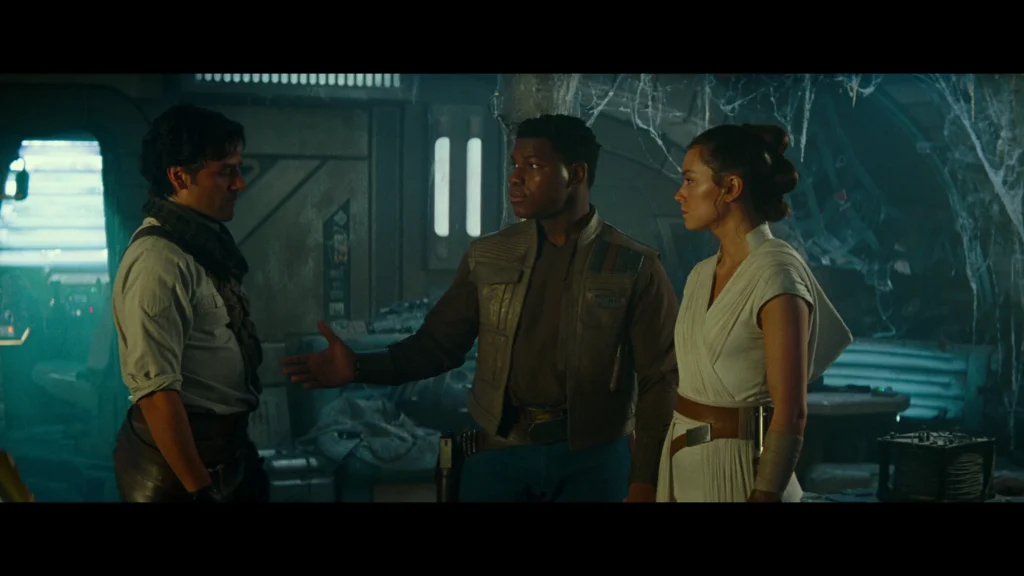
    Demonstrating the power of this fully armed and operational randomiser, we are thrown from the start of the film to the very end. It’s a good scene to get out of the way here though, because it’s entirely disposable but it gives us an introduction to near every major character appearing in this film: Poe, Finn, Rey, Chewie, C3P0, BB-8, the nerd, the slug, fan favourite returning champion Maz Kanata, someone named Jannah, Zam Wesell Zori Bliss, miscellaneous other droids, and of course Lando Calrissian himself: the great Billy Dee Williams. Collectively they are team ‘good guy’ and they’ll be operating out of this forest-jungle positioned at the exact midpoint of Yavin and Endor for most of the film.

    Something the film never quite manages to convey properly as an image is that they’re working in and around the good old Tantive-IV of A New Hope fame. Because the Tantive-IV is not particularly notable in its details, owing to how it was created by ILM as a kitbash model, there’s no real moment of recognition from seeing odd corners of it. Rather than a recognisable (if slightly aged) point of reference, it ends up working more like the generic sets TV shows used to use in studios; like they’re moving around four or five large white boxes to give the impression of a larger space. Plot-wise, it contributes to the sense that this is a Resistance that is working out of a suitcase, but really it’s the entire film production – some of the toughest material in the film will be set here, in among these anonymous fronds where all the actors listed above will be rattling off lines at an unruly pace as they attempt to keep the plot coherent scene-to-scene.

    As a parallel to the celebration ending of Return of the Jedi this is oddly curtailed, a whistle-stop tour of all our favourites being just about happy. John Boyega is a great actor, but he is tasked with delivering a superhuman number of slightly ambivalent smiles here. Still, Poe and Finn get to share a platonic, non-suggestive reunion. Which is nice.

    Fan favourite character Maz Kanata, who is one of several characters who are going to be doing a lot of odd proxy behaviour for an absent Leia, gives Chewie a medal. It’s an odd acoutrement for a character who doesn’t wear clothes. Perhaps he can put it on the wall of his parents’ house.

    Much like the extended universe novels, Rise of Skywalker knows there’s one decision that will improve any situation and that’s to hit the “Also, Lando’s there” button, so he makes his first (non-chronological) appearance right here, sharing a curiously loaded scene with Naomi Ackie’s Jannah, a new character for this film of whom I know nothing. Fortunately I can simply turn to Google to find out what’s going on here:

    Phew.

    Lando count: 1

    Next: Kylo calls Rey on the force telephone

  • Scene #1: Sheev explains the plot of the film

    Scene #1: Sheev explains the plot of the film

    Part 1 of 43 Individual Scenes from ‘Rise of Skywalker’

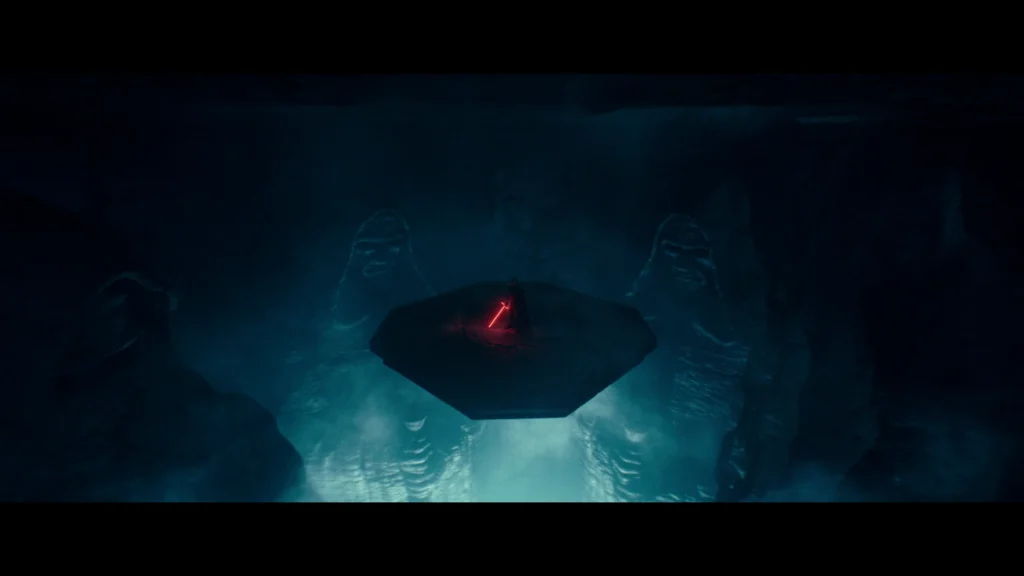
    Absolutely impeccable way to open this or any film. Straight in, no messing around, Big Sheev himself going full ham and chewing his way through the classic Lucas line “The dark side of the Force is a pathway to many abilities some consider to be unnatural” as Kylo Ren stalks his way through a set that might belong better in some forgotten Alien sequel, were it not for the giant jar of Snokes – an economy in storytelling that will be needed, given it’s the most in-depth explanation we ultimately get for this place and the horde of hooded underlings who run it.

    Palpatine really lays out the entire plot here, which again is fantastic to be arriving at as the first encounter with the movie. I couldn’t have asked for a better opening scene, and as well it even looks great: murky and uneasy with a proper jump scare as we see Palpatine’s face for the first time, before Kylo Ren swings his crossbar lightsaber up to strike the old man down. Alas he cannot, for Sheev’s whispered entreaties have snared his pride and (we think) he has truly become a second Vader, kneeling before the dark master.

    What clicks at this point, and it’s something I think holds true through the rest of the film, is that this isn’t really a sequel to The Last Jedi. It’s not a film that continues that story in any way, shape or form. This is, firstly and solely, a sequel to the Palpatine Fortnite event. We aren’t expected to be surprised that Palpatine is back in action. We are expected to be surprised that he looks like a corpse as flashes of lightning (turn off that strobe, underling!) repeatedly highlight the deep lines in his rotten old face. The narrative is grown entirely out of the “message to the universe” of Palpatine’s return, and the question of (just to pick one) who or what Snoke was trying to do in those previous films isn’t getting any more attention from hereon in.

    Palpatine throws up his hands and from the very earth a giant fleet bursts forth in a wildly out-of-scale take on the classic living dead moment. This is not a film that is made to make sense. We’re in the world of dreams and images, and Sheev’s blind cataract eyes glimmer as he offers Kylo Ren the force of his “Final Order”, a pun delivered with no ceremony at all. I only hope the film stays this good.

    We’re going to need one hell of a Skywalker to sort this mess out.

    Next: Maz Kanata gives Chewbacca a Medal

  • 43 Individual Scenes from ‘Rise of Skywalker’

    43 Individual Scenes from ‘Rise of Skywalker’

    Introduction

    At last the work of generations is complete. The great error is corrected. The day of victory is at hand. The day of revenge. The day of the Sith!

    • Emperor Palpatine [Fortnite, 2019]

    At the end of 2019 I faced one fateful choice about the path my movie-watching would take for the next six years. Obviously, I chose to go see CATS. The rest is history.

    Despite being the anointed finale to all of Star Wars, Rise of Skywalker just didn’t hold any appeal for me, having only begrudgingly and belatedly caught up with The Force Awakens and The Last Jedi well after the dust had settled on those two films. At root, I just wasn’t that interested in seeing the story of Star Wars continued by anyone other than George Lucas, and that had been taken off the table in 2012. So I just didn’t bother. And nothing I’ve heard since about Rise of Skywalker suggested to me that I was wrong. That it’s a mess, that it’s incoherent, that it throws out everything from the previous movie, and so on. That it’s so bad that it poisoned the entire sequel trilogy, to such an extent that Disney don’t even seem to be able to operate the great beast any more: the only Star Wars movie since has been notable non-sequel era effort The Mandolorian and Grogu, and that flopped anyway.

    But over time, hearing this universally negative response starts to form its own attraction – and I’m no stranger to finding love for big franchise movies that get torpedoed by executive interference. Suicide Squad being my white whale, there’s something really fun about trying to reassemble the jigsaw on one of these films that’s obviously come out of the oven not-quite-right. It was inevitable that I was going to watch Rise of Skywalker at some point.

    I’m also interested, when I’m writing at least, in the Big Concept. My Suicide Squad essay was built out of a succession of smaller essays that failed to cohere by themselves. I previously looked at the first season of Invincible – a show built around a last-minute twist – starting at the end and working back. Back in 2023, coming away from watching the Obi-wan show and contrasting it with The Phantom Menace, I had the big idea for looking at Rise of Skywalker: what if the film, which many people are happy to describe as being made of events happening almost at random, was literally assembled in a random order?

    Video games provide a concept here: the ‘randomiser’, a user-made modification that shuffles some aspect of gameplay to provide a unique challenge. Why couldn’t a movie have a randomiser? A day or so of effort later, the Rise of Skywalker Randomiser was complete. Using scene select timestamps, a script skips between scenes of the movie in a predetermined random order. Rise of Skywalker, rather than merely figuratively having no connection between one scene and the next, really could have scenes occur in a random order.

    And then I just never did it. The moment didn’t strike me. I held off on seizing my destiny. Until now! Three years later, I have finally watched Rise of Skywalker in fully random order. And I want to assess it in a format appropriate to the viewing, an essay on each individual scene in the random order which I came to it, for a total of 43 short essays on Rise of Skywalker as well as this introduction and a conclusion post.

    It’s going to be fun.

    Next: Sheev Explains the Plot

  • Books 6

    Books 6

    Books? Care for some books, Madam? Can I interest you in a short review of a book? Yes I can!

    Clarissa Oakes – Patrick O’Brien

    As is often the case with these later Master and Commander books, O’Brien is going back over ground already trodden – in this case the difficulties presented by having even a single woman present in the all-male environ of the Royal Navy ship at sea. In this case though it’s a well-deserved barnstormer, the titular Oakes an excuse to lay out in exacting detail how discipline and good manners aboard slowly disintegrate

    The dénouement is slightly contrived, with Oakes letting slip some essential puzzle piece in a casual conversation to Stephen ‘James Bond at sea’ Maturin, but otherwise it’s still astonishing how much O’Brien is getting from what is now a very long-in-the-tooth setting. Also he still hates Australia.

    Case Study – Graeme Macrae Burnet

    A funny one this, presented in the infamous modernist framing story where the author is provided with a bundle of papers, these ones alternating between a biography of a fictional enfant terrible psychotherapist in the 60s and the macabre diary of one of his latter-day patients. I found the slightly trashy diary sections preferable to the more literary biography, which despite being humourous and well put together was a bit much like reading an actual biography of a psychotherapist, which I wouldn’t often do.

    The Book of CP-System – Fabien Sanglard

    Despite owning both Sanglard’s Game Engine Black Book: Wolfenstein and Game Engine Black Book: Doom, I wasn’t going to bother with this one as I have no particular connection to or affection for arcade machines; somehow however I got sucked into reading it during lunches at work. And it’s excellent, a detailed and fascinating breakdown of one of the great pieces of custom arcade hardware and what must have been involved in putting together games for it. I’d buy a physical copy but the price of Amazon’s print-on-demands is, uh, considerably more than I remember.

    Shadows of the Empire – Steve Perry

    Look, all respect to fan favourite character Dash Rendar but this is not a good book. Partial mark for the characterising Darth Vader as a sort of long-suffering Smithers to the Emperor’s Mr Burns, but everything else is tedious at best and gratuitously sexist at worse. I posted a round-up of some of the most Marenghi-like sentences.

    He Who Whispers – John Dickson Carr

    Back on the Dickson Carr, this one’s a real firecracker with each act taking place in an outlandishly gothic setup. There’s a central London dinner club no-one has turned up for, a man murdered alone atop a great stone tower, and sneaky goings-on in a New Forest stately home. Still sexist though.

    Inversions – Iain M. Banks

    I took the dive and read the last Banks Culture book I hadn’t covered. Turns out this was a great one to leave till last, knowing all the usual Culture series tics made spotting them from the outside in this inverse telling very satisfying. But the story stands as a fantastic bit of sci-fi all by itself, the story of nations – and by extension worlds – being given gentle nudges in the direction of what you might call progress by two different (but ultimately very similar) outsiders. Only flirts with the kind of ultra-violence that Banks tones down from this point on in the series, but was very prominent in e.g. Use of Weapons. It’s a slow burn in general, without much of the kind of action denouement Banks likes to give to the Culture novels. All the more memorable for it.

    The Long Shoe – Bob Mortimer

    Picked up this Bob Mortimer book at my Mum’s and read it over a weekend. Mortimer has such a distinctive patter that it can be distracting at first to read paragraphs written in his style, though he does occasionally throw it out and fill in a chapter or two from an outside perspective just to show he can. The plot is mostly nonsense, this is entirely about hanging out with the character sketches, so it’s a shame that some of them here are a little stale – ‘South London lifestyle yoga instructor’ is very mid-2000s – but I did enjoy it.

    A Game in Yellow – Hailey Piper

    I feel like I missed a lot of references and allusions here by not having read Chambers’ The King in Yellow. Having bought it entirely from seeing the cover in a bookshop window (I don’t read much horror), it was an enjoyable read on its own merits, a story of terminal self-sabotage with a strong noir flair. The depiction of BDSM is unusually authentic, almost to a fault. Like writing sex scenes as a whole, too much attention to detail can draw out the absurdity. That said, I’ve certainly read worse.

    Thrawn – Timothy Zahn

    I wasn’t expecting much from Thrawn 2.0 but Zahn really pulled out all the stops here, having been given the chance to start again and do Thrawn ‘right’ twenty five years after first writing the character. He turns in something which is actually kind of on the pulse of genre writing, with a handful of characters – Thrawn, his provincial attache Vanto and disinherited mining magnate Pryce – who are all in some way trying to serve an Empire that is inherently hostile to them. Shades of A Memory Called Empire or The Traitor Baru Cormorant, and Pryce’s story in particular is that kind of bureaucrat power play porn, culminating in her commiting an atrocity. The trick of the book is to get you to root for these bozos. It’s not Proust, it’s still a Star Wars book and it in fact directly ties in to a season of a children’s cartoon where Thrawn is a moustache-twirling characature, but I enjoyed this a lot more than I expected.

    Anathem – Neil Stephenson

    Scurrilous monks! I’d have been happy had they never left that monastery (or ‘concent’, as the book’s alien phraseology would have it) and they were just Name of the Rose-ing it up for 900 pages. In the event this was still a very wild ride, with the constant reconfiguration of setting and mystery meaning that the high page count flew past. It occasionally becomes a bit “Boy’s Own Adventure Weekly” with the regularity with which our motley protagonist Erasmus and crew are placed at the centre of attention, to the point where there’s an extremely jarring part where Erasmus returns to his formal rank within the order he’s part of and it just feels bizarre.

    It’s possibly the most end-of-history book ever written, albeit with a kind of strange optimism to it despite the deeply, utterly cynical account of human nature it presents. The philosophical and mathematical asides were fine, it’s something of a novelty to see phenomenology represented at all in literature, let alone as a positive development, so I appreciated that.

    Previously: