Category: Blog

  • Books 6

    Books? Care for some books, Madam? Can I interest you in a short review of a book? Yes I can!

    Clarissa Oakes – Patrick O’Brien

    As is often the case with these later Master and Commander books, O’Brien is going back over ground already trodden – in this case the difficulties presented by having even a single woman present in the all-male environ of the Royal Navy ship at sea. In this case though it’s a well-deserved barnstormer, the titular Oakes an excuse to lay out in exacting detail how discipline and good manners aboard slowly disintegrate

    The dénouement is slightly contrived, with Oakes letting slip some essential puzzle piece in a casual conversation to Stephen ‘James Bond at sea’ Maturin, but otherwise it’s still astonishing how much O’Brien is getting from what is now a very long-in-the-tooth setting. Also he still hates Australia.

    Case Study – Graeme Macrae Burnet

    A funny one this, presented in the infamous modernist framing story where the author is provided with a bundle of papers, these ones alternating between a biography of a fictional enfant terrible psychotherapist in the 60s and the macabre diary of one of his latter-day patients. I found the slightly trashy diary sections preferable to the more literary biography, which despite being humourous and well put together was a bit much like reading an actual biography of a psychotherapist, which I wouldn’t often do.
    The Book of CP-System – Fabien Sanglard

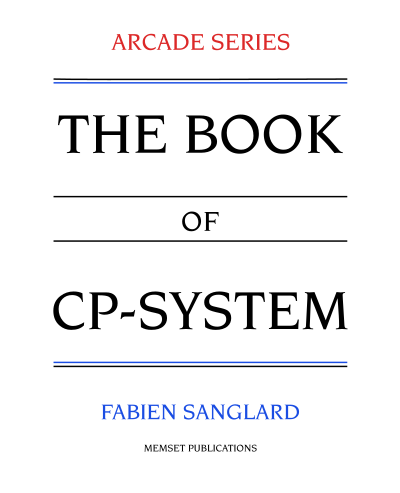
    Despite owning both Sanglard’s Game Engine Black Book: Wolfenstein and Game Engine Black Book: Doom, I wasn’t going to bother with this one as I have no particular connection to or affection for arcade machines; somehow however I got sucked into reading it during lunches at work. And it’s excellent, a detailed and fascinating breakdown of one of the great pieces of custom arcade hardware and what must have been involved in putting together games for it. I’d buy a physical copy but the price of Amazon’s print-on-demands is, uh, considerably more than I remember.

    Shadows of the Empire – Steve Perry

    Look, all respect to fan favourite character Dash Rendar but this is not a good book. Partial mark for the characterising Darth Vader as a sort of long-suffering Smithers to the Emperor’s Mr Burns, but everything else is tedious at best and gratuitously sexist at worse. I posted a round-up of some of the most Marenghi-like sentences.

    He Who Whispers – John Dickson Carr

    Back on the Dickson Carr, this one’s a real firecracker with each act taking place in an outlandishly gothic setup. There’s a central London dinner club no-one has turned up for, a man murdered alone atop a great stone tower, and sneaky goings-on in a New Forest stately home. Still sexist though.

    Inversions – Iain M. Banks

    I took the dive and read the last Banks Culture book I hadn’t covered. Turns out this was a great one to leave till last, knowing all the usual Culture series tics made spotting them from the outside in this inverse telling very satisfying. But the story stands as a fantastic bit of sci-fi all by itself, the story of nations – and by extension worlds – being given gentle nudges in the direction of what you might call progress by two different (but ultimately very similar) outsiders. Only flirts with the kind of ultra-violence that Banks tones down from this point on in the series, but was very prominent in e.g. Use of Weapons. It’s a slow burn in general, without much of the kind of action denouement Banks likes to give to the Culture novels. All the more memorable for it.

    The Long Shoe – Bob Mortimer

    Picked up this Bob Mortimer book at my Mum’s and read it over a weekend. Mortimer has such a distinctive patter that it can be distracting at first to read paragraphs written in his style, though he does occasionally throw it out and fill in a chapter or two from an outside perspective just to show he can. The plot is mostly nonsense, this is entirely about hanging out with the character sketches, so it’s a shame that some of them here are a little stale – ‘South London lifestyle yoga instructor’ is very mid-2000s – but I did enjoy it.
    A Game in Yellow – Hailey Piper

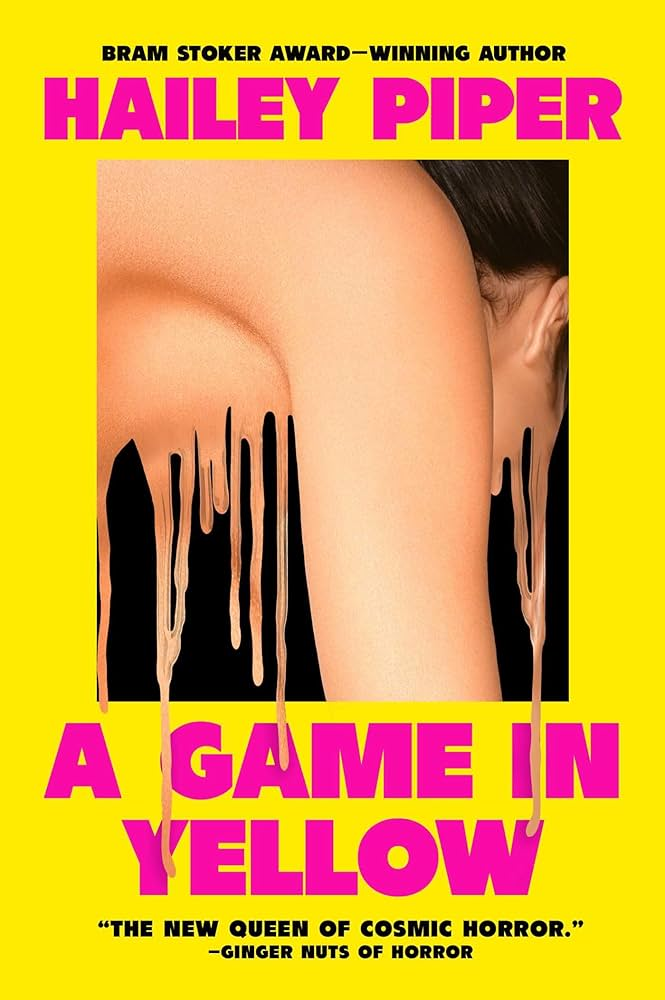
    I feel like I missed a lot of references and allusions here by not having read Chambers’ The King in Yellow. Having bought it entirely from seeing the cover in a bookshop window (I don’t read much horror), it was an enjoyable read on its own merits, a story of terminal self-sabotage with a strong noir flair. The depiction of BDSM is unusually authentic, almost to a fault. Like writing sex scenes as a whole, too much attention to detail can draw out the absurdity. That said, I’ve certainly read worse.

    Thrawn – Timothy Zahn

    I wasn’t expecting much from Thrawn 2.0 but Zahn really pulled out all the stops here, having been given the chance to start again and do Thrawn ‘right’ twenty five years after first writing the character. He turns in something which is actually kind of on the pulse of genre writing, with a handful of characters – Thrawn, his provincial attache Vanto and disinherited mining magnate Pryce – who are all in some way trying to serve an Empire that is inherently hostile to them. Shades of A Memory Called Empire or The Traitor Baru Cormorant, and Pryce’s story in particular is that kind of bureaucrat power play porn, culminating in her commiting an atrocity. The trick of the book is to get you to root for these bozos. It’s not Proust, it’s still a Star Wars book and it in fact directly ties in to a season of a children’s cartoon where Thrawn is a moustache-twirling characature, but I enjoyed this a lot more than I expected.

    Anathem – Neil Stephenson

    Scurrilous monks! I’d have been happy had they never left that monastery (or ‘concent’, as the book’s alien phraseology would have it) and they were just Name of the Rose-ing it up for 900 pages. In the event this was still a very wild ride, with the constant reconfiguration of setting and mystery meaning that the high page count flew past. It occasionally becomes a bit “Boy’s Own Adventure Weekly” with the regularity with which our motley protagonist Erasmus and crew are placed at the centre of attention, to the point where there’s an extremely jarring part where Erasmus returns to his formal rank within the order he’s part of and it just feels bizarre.

    It’s possibly the most end-of-history book ever written, albeit with a kind of strange optimism to it despite the deeply, utterly cynical account of human nature it presents. The philosophical and mathematical asides were fine, it’s something of a novelty to see phenomenology represented at all in literature, let alone as a positive development, so I appreciated that.

    Previously:
  • Label Maker Devlog 2

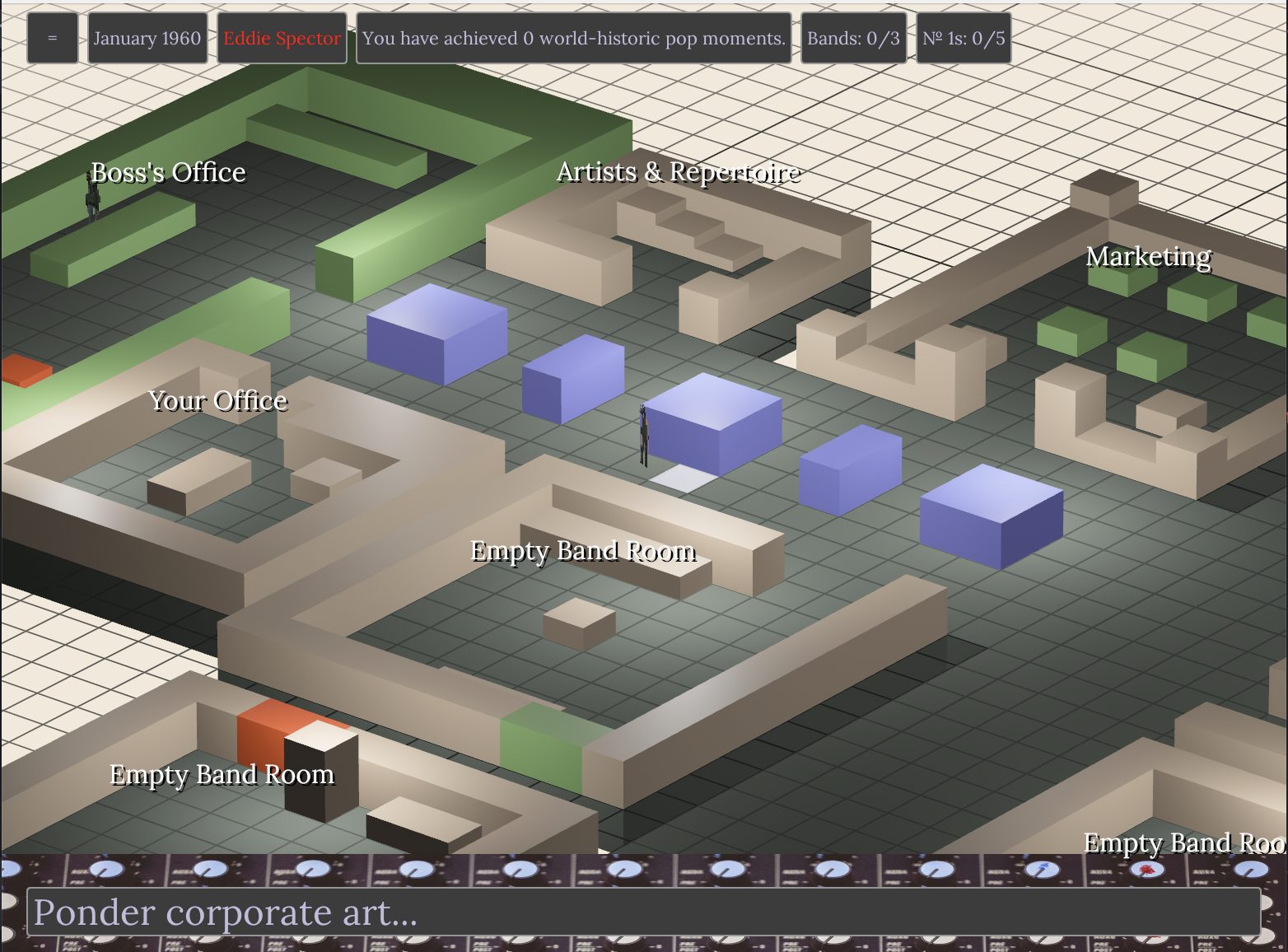
    First off the bat, since the last time I posted about my game I thought up a much better name. ‘Gentle People‘, a reference to the Scott MacKenzie lyric, was a bit opaque and it’s not like the game is particularly 60s-themed any how, despite nominally being a representation of that period. ‘Label Maker‘ is more dynamic and snappy, and crucially it’s also a pun. No-one can dislike a pun.

    One of the things you don’t necessarily expect about game development is how slow it is – though you might guess from the curious emphasis on speed that all the various gamedev tools boast about. It often resembles nothing so much as attempting to build a ship in a bottle, with vast amounts of effort going into the placement of tiny bits of rigging and polish. Having sprinted all the way to having a 3D environment for the game to take place in, actually having things occur there is a long, slow process.

    For example, in the last few weeks I have put multiple days work into two fairly trivial problems: one, having a band of four or five people walk to the elevator, disappear, then return, and two having a single person walk to the break room and back. The former required some way to know when a band was ‘off-stage’, so to speak, and the latter required being able to figure out where someone should go back to according to their role and the current state of the game. Neither was trivial to do!

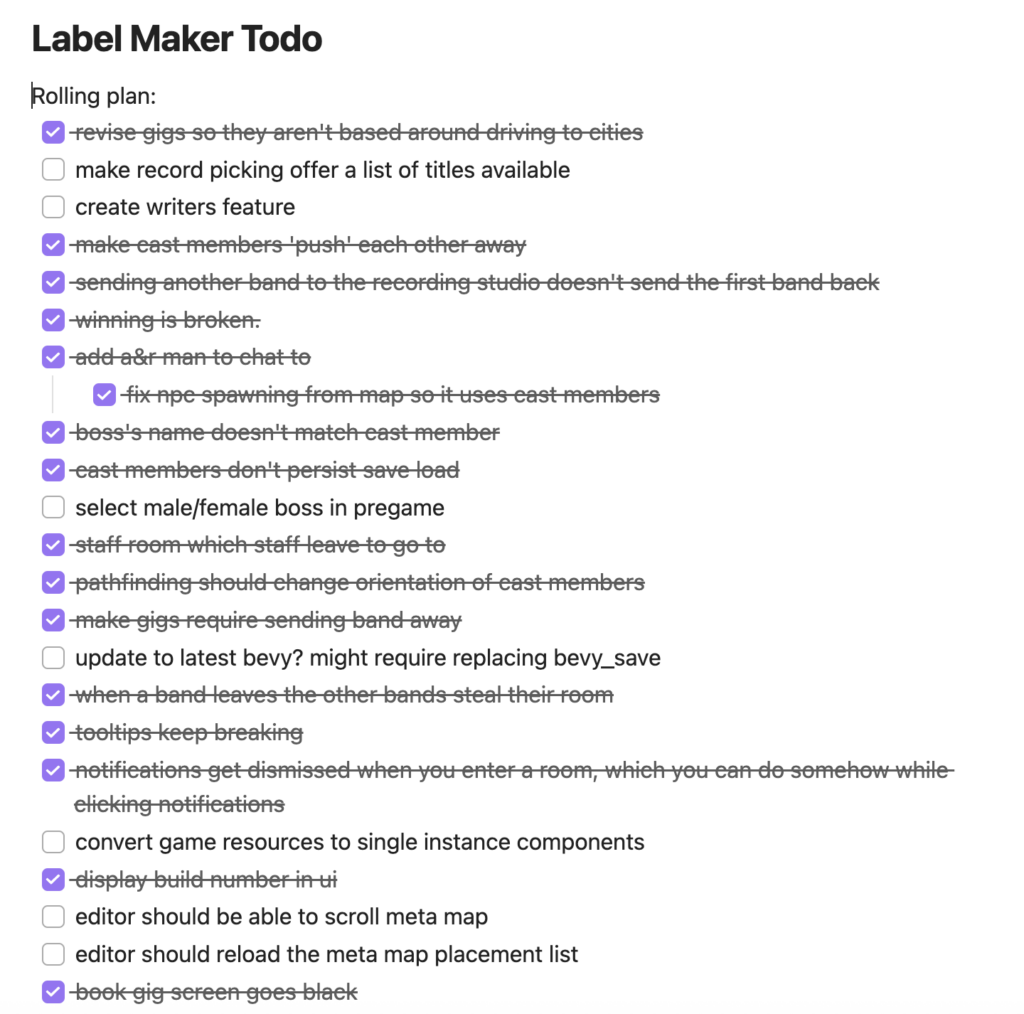
    A selection from my todo list for Label Maker.

    As you can see towards the top, I’m currently implementing a feature where you manage a stable of songwriters in addition to bands, so that bands can cover each others songs and play standards – or be singer-songwriter setups who are deeply concerned with authenticity and all that. I also think there’s something inherently fun in giving the player some agency in picking the name of the song, even if it’s just from a limited list.

    I’ve also been working through adding a bit of visual interest to the game: specifically, walking animations for the little people and instrument items for the relevant band members to carry. As well, I’ve made the floor of rooms where you can do something flash yellow when hovered, to nudge you into clicking into them.

    All this new work has paused updates to the web build for some months. I’m almost ready to post a new release, but I need to go over to Itch at some point and replace all the assets that reference the old name. Not the first time I’ve had to do this either! The early prototypes for this were called ‘Culture Prototype‘ on Itch (to pair with ‘Swat Prototype’ for the narrative 3D game I didn’t make).


    Previously: Devlog 1

    Recently: Books, Poirot

  • Books 5

    Another plate of books served at the great banquet of reading books:

    Eight Detectives – Alex Pavesi

    Vaguely po-mo succession of detective yarns with a framing story about a reclusive writer of the stories in question. Always a risk with the high concept that the high concept part will fail to be as compelling as the low concept muck that it’s supposed to be above, and that’s the case here – the book is by far at its weakest at the end when it’s all supposed to be coming together. That said, the short stories themselves are compelling and memorable, with great atmosphere.

    A Memory Called Empire – Arkady Martine

    Curiously close in concept to The Traitor Baru Cormorant, even if all the specifics are different. Really enjoyable intrigue and fairly unique depiction of being an enthusiast for a culture that is trying to consume your own. I don’t know if the chauvinism of the Imperial subjects is ever totally convincing – everyone’s very buddy-buddy even when the heat is on. But it’s fun regardless. I haven’t picked the sequel up yet because I’m too worried it will be totally different, which is a slightly ridiculous concern.

    The Letter of Marque – Patrick O’Brien

    The Thirteen-gun Salute – Patrick O’Brien

    The Nutmeg of Consolation – Patrick O’Brien

    These really do form one continual narrative at this point, despite O’Brien paying lip service to catching new readers up at the start of each one, so I’m not going to bother trying to divvy them up for review. That said, it’s a great narrative, with Aubrey and Maturin setting off in a tacitly approved privateer after Aubrey was unfairly struck from the Naval lists. The ensuing string of missions are as good as anything else in the series, with Maturin’s visit to a sadly fictional crater ecosystem a real highlight. Also, O’Brien really hates Australia.

    The Truce at Bakura – Kathy Tyers

    Another entry in my big journal of Star Wars sequels and prequels, this is the book that infamously starts the moment Return of the Jedi ends, by having fan-favourite X-Wing pilot Wedge Antilles trip over his shoelaces and hit his head on an exploding Imperial Droid. Hijinks ensure.

    Tyers has a much looser grip on the Star Wars atmosphere than Zahn did, and the mid-nineties sci-fi pulp mood that you might also see in Doctor Who novels of that era is very much in evidence: Skywalker et al must contend with the threat of a vast empire of oddly sexy dinosaur-men. That’s not very Star Wars, but the constant diplomatic back-and-forth with the newly-minted Imperial remnant, who aren’t entirely convinced that the Emperor is dead, certainly is, and Tyers does a decent job of depicting power struggles in a very febrile situation. Takes a while to hit its stride, but an enjoyable read once it does.

    Samurai Detectives Vol 2 – Shotaro Ikenami

    More of the Samurai Detectives. Sadly less of the austere son character Akiyama Daijiro in this one, with the focus almost entirely on Akiyama Kohei and his Sherlock Holmes-esque network of spies and investigators. It’s still fun, and you can tell the author is loving being fully immersed in the Shogunate era in much the same way O’Brien is for the Napoleonic, but the always-on-top escapades of Kohei start to blur into one another a little bit. I want to see him (or his son) on the ropes a little bit here. Even Holmes has stories like Adventure of the Copper Beeches where he just fucks everything up a bit.

    After Hours At Dooryard Books – Cat Sebastian

    Has the unusual quality of being a story where most if not all of the major events occur off-page before the book has begun – perhaps this is what earns it the epithet ‘cozy’, though there’s rather more referencing of CIA misadventures during the Vietnam War in this one than I was anticipating given the remit. I don’t know how cozy I felt coming away from it, although the characters are very well realised, to the point where when things get a little steamy it almost seems prurient – leave these poor guys alone to it, they deserve some privacy after all that.

    The Great When – Alan Moore

    I do struggle with Moore as a prose writer, the great swamps of description that make him well-suited to comic book writing were very much an obstacle to enjoying Jerusalem a few years back. The Great When is both easier to digest and shorter than that tome, and selfishly I’m more familiar with the streets of London as a setting for psycho-geographic fantasy than I am those of Northampton. Much rueful musing on the nature of Britain’s relationship to the Second World War and the Blitz. Four sequels still to come, apparently, which will hopefully mitigate the feeling you get of seeing an extremely small slice of the larger world Moore is dreaming of here.

    Death Comes for the Archbishop – Willa Cather

    God, this was stunning. Crisp, simple prose belies a sketch of two muddling Priests in nascent New Mexico that is overflowing with compassion, exhilaration at the beauty of the natural world, and yet at the same time a level view of America and the construction thereof, winners and losers and all. A fascinating companion to something like Wolf Hall, historical fiction that is dreaming the characters of these real people, or Wittgenstein’s Nephew, artful and audacious meddling with minor characters of recent history. In the public domain, too.

    Previously:

  • Gentle People Devlog I

    I’ve been working on my current video game project, ‘Gentle People‘, for just over two years now and back in September 2025 I hit an ostentatious milestone: the game was, for the first time, basically fun to play. This is not at all a straightforward thing to achieve in making a video game, and my list of past projects (mostly unfinished) is a testament to that. My goal in working on this new game had been to prioritise prototyping the game mechanics, the win-lose-draw aspect of the whole thing, above all else. And it had worked!

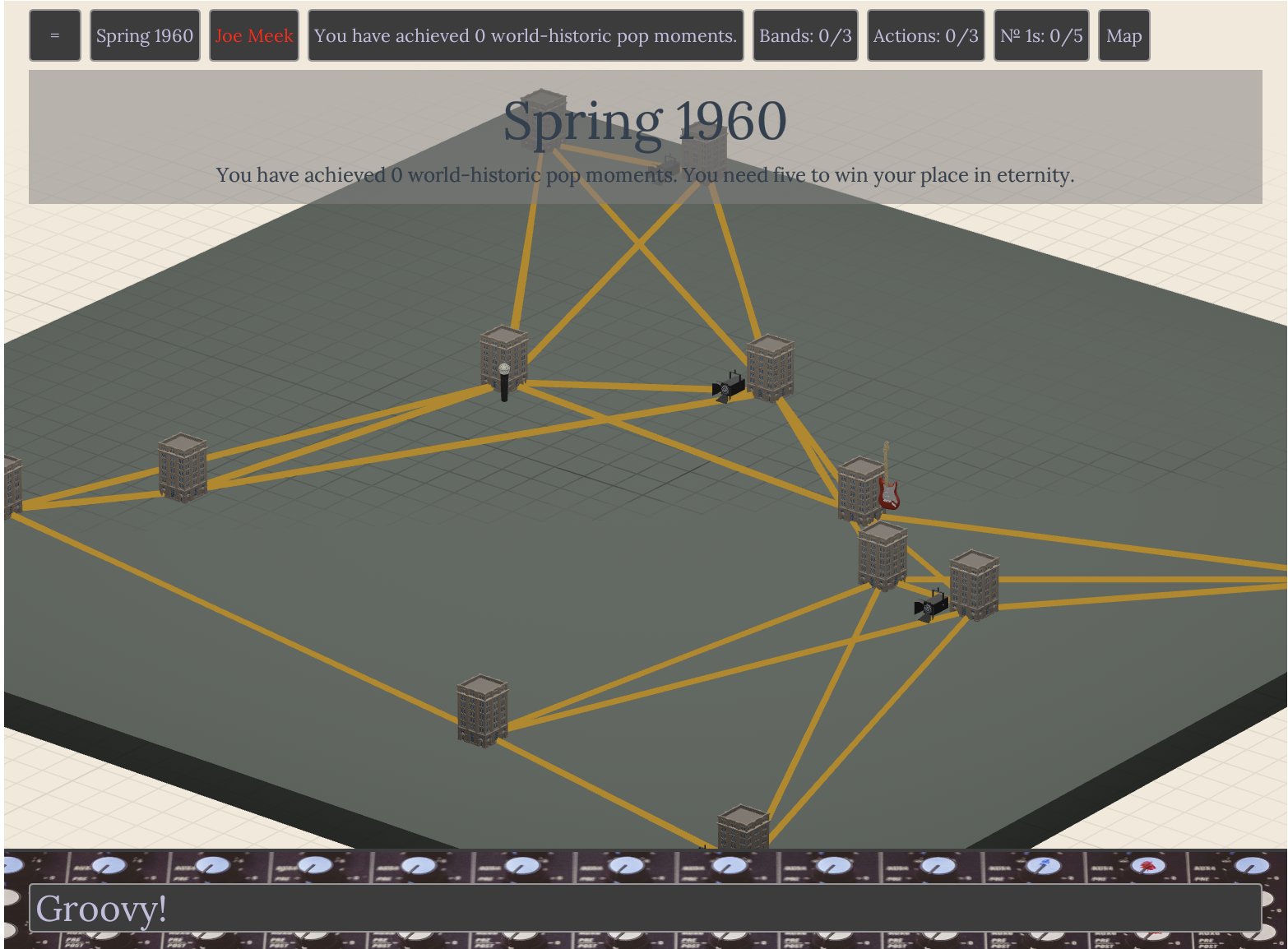
    Naturally, on having this realisation I decided to go straight back to the drawing board. Here’s what I had:

    My initial concepts for the game, a band management simulator, were based entirely around the idea of shuffling bands between cities to record albums and play gigs, and so the main interface had ended up being this pseudo-world map with cities represented by Monopoly-esque tower blocks and routes between them drawn with rudimentary golden lines. Along the top you’ve got some important numbers: the season and year, which amount to the turn number, a count of how close you are to winning (‘historic moments’), how many bands you currently manage, how many actions you can make in each turn, and how many number ones you’ve had (five together get you a historic moment). Down at the bottom there’s space for buttons, which are the primary way you interact with the game (you can click the city models, for example, but there are also buttons for doing the same). As you and the AI players sign bands, they appear represented as little static people moving between cities.

    Put simply, this is a very boring interface. The excitement of the setting – inspired surely by my listening to Andrew Hickey’s excellent History of Rock Music in 500 Songs – is the interpersonal stuff, the drama, the who’s-in-who’s-out of it all, and while that stuff can’t really be the way you win the game, having it all visually stuffed into text-based side menus seems like a terrible waste.

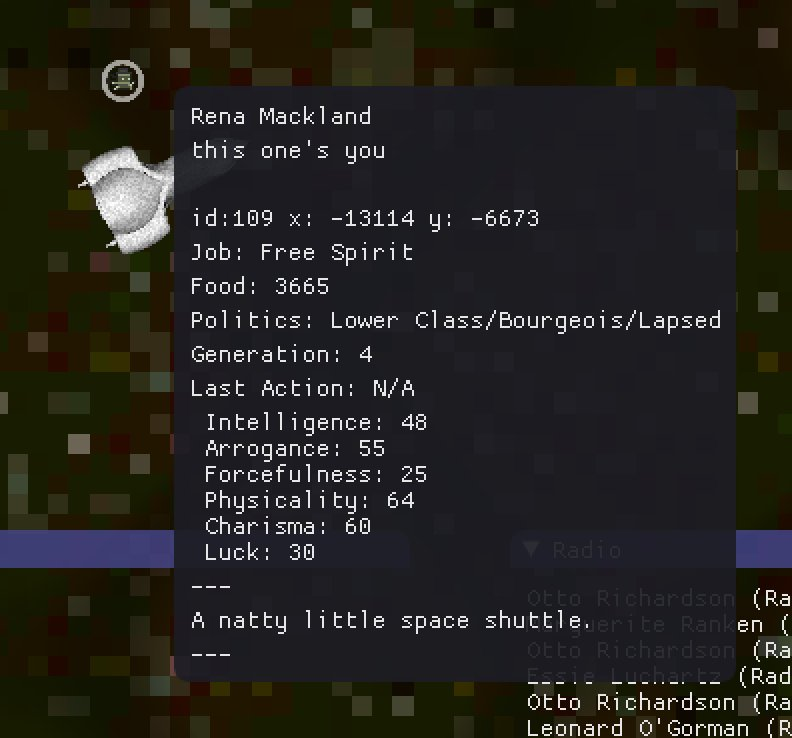
    _space_train taught me the power of throwing a bunch of little descriptors at made-up people.

    So: the drawing board. What I want, on a base level, is to maintain the gameplay of booking gigs and releasing records, but with the player feeling like they’re there, in the background of some documentary about the Beatles, pulling the strings. Put simply: seeing some tiny little people moving about would make this way more compelling – one of the best things about _space_train (my first and most sprawling gamedev effort) was the permanent cast of personality-driven little aliens scurrying about the train around you. But that means having the game take place somewhere – there has to be a building that both the band and you, the manager, are plausible in at the same time. I went for an odd combination of the label corporate office and recording studio for the moment, with a pin in the idea of how to represent gigs for later.

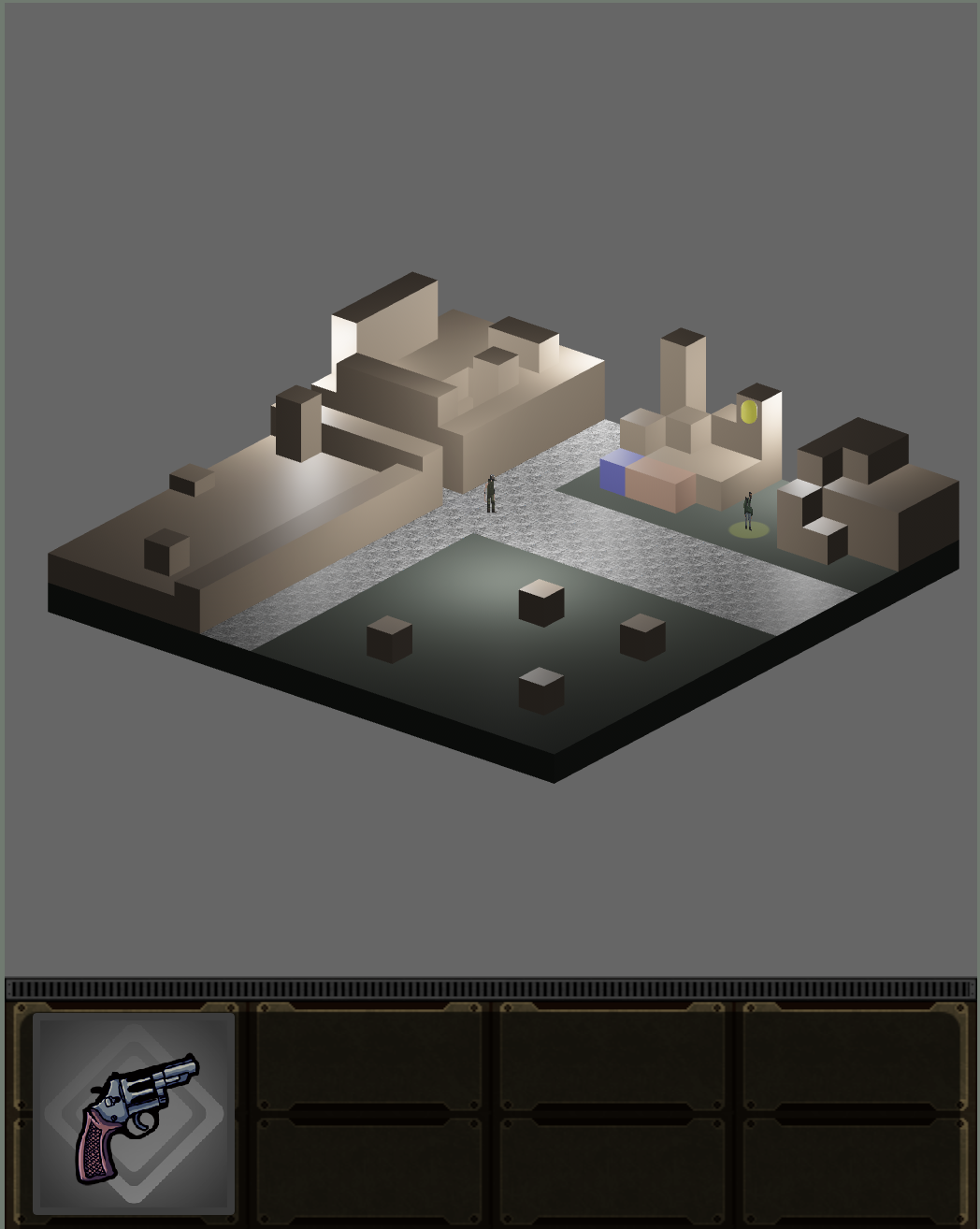
    swat was going to be an all-narrative game with a vaguely cyberpunk bent. I only stopped working on it because I got distracted by Gentle People – so it goes.

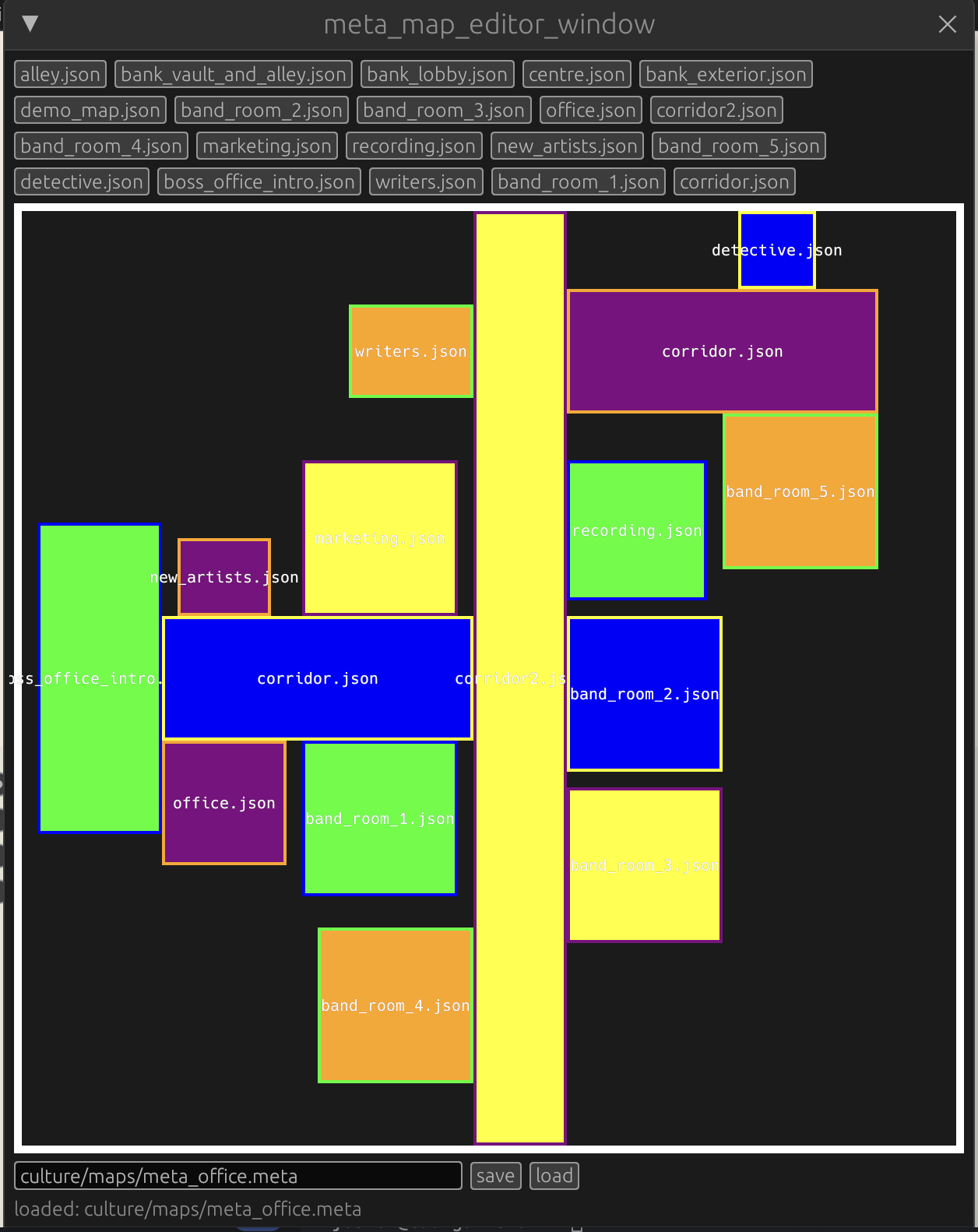
    Cue lots of feverish coding between September and now for adding the capacity to draw a tiny little office and place a character in it to walk about; I was lucky in this regard that I was building Gentle People on top of a previous game effort I’d called ‘swat’ because the look of it was inspired by what I could remember of SWAT 2. That had a little person who walked about, but only between individual square dioramas. I had to do lots of wrangling to extend it to draw arbitrary-sized offices and then on top of that add a concept of ‘rooms’, because I was imagining that to perform different music industry tasks you’d need to walk to the relevant department at the label (still not entirely convinced this won’t be tedious in practise, we will see.) swat had an existing map editor, which was handy, and rather than adapting it to edit maps of arbitrary shape I instead put in another layer of ‘meta-map’, and an editor for gluing together lots of diorama maps into a larger whole.

    The meta-map editor. Might need to revise those colours.

    With all this in place I just needed to map the existing gameplay functions onto these rooms, which wasn’t too awful – though the big function that draws the entire UI is getting on for 1600 lines of code now. I’m resisting the urge to try and do something clever to break that down, thinking fondly of VVVVVV‘s 8000-case state machine.

    This is where I’ve got to; lots of effort the past few weeks has gone into fixing various things that broke along the way, such as saving/loading, the rendering of some floating icons in the intro, that sort of thing. But I’m now back at the point where the game is mechanically playable, and just about fun, but with a much more engaging set of visuals. The next step will be to add the tiny little band members running about and go from there. The best thing about working on a game like this is constantly feeling like I’m about to add the feature that turns it from something functional to something absolutely amazing; the worst part is actually trying to add that feature and finding that it will take ten times as much work as expected.

    Please, if you enjoyed this then read me talking about Poirot.