Tag: Star Wars

  • Ahsoka (episodes 7 & 8)

    Last time I was struggling to care about Ahsoka.

    Can’t lie, that fleece looks so cozy. Buy me an Ahsoka fleece.

    I left off last time equivocating over whether Ahsoka would achieve more in its eight episodes than a set of filmed warm-up sessions for some future cinematic release. Unfortunately, and really somewhat unexpectedly, it hasn’t. The events of the series, crafted to fill the moments immediately preceding the plot of an as-yet unfilmed movie, were circumscribed so closely that in the end you can list all in brief — Sabine is training with Ahsoka now, Thrawn has flown back from whale exile. Witches abound. Ray Stevenson’s character exists.

    It’s clear in retrospect that nothing was permitted to happen that might close off a possibility for the upcoming movie and so all the big set-pieces only open up ideas and never close them off. The two rogue Jedi never explain their whole deal. The zombie Stormtroopers only really pop in to say ‘Hi’. The movie — ‘Heir to the Empire’, if you hadn’t heard — even has the option to leave the cast of this show entirely out of frame if Lucasfilm decide they’d rather have a fresh protagonist.

    Look, I get that making them zombies has its own particular appeal but they’re already a faceless legion. Thematically I’m not sure what you’re getting here.

    ‘Less than the sum of it’s parts’ is my ultimate verdict, and the sum of the parts wasn’t all that grandiose in itself. A loose-floating prologue, dispensable on its own terms, a free comic book day introduction to a pre-existing character in the middle of an extended up. Superhero comics suggest themselves as an analogue — Star Wars’ own Countdown to Final Crisis. This is all a bit mean, but I think the ability to appreciate this show is dependant — much like a comic book — on preexisting familiarity with the characters. I don’t have it!


    In a slightly laughable retread of the bleak final moments of Obi-wan, Ahsoka goes out with a lingering shot of Anakin Skywalker himself — an always-welcome Hayden Christensen once more — as a shimmering force ghost, casting a neutral expression verging on a smile at the departing Ahsoka. The cliffhanger ending — in case you don’t know — leaves all the main characters trapped out in space with no route home, awaiting the benevolence of a noble space whale, no doubt. But the viewer’s heart is warmed knowing that the ghost of interplanetary youngling murderer Anakin Skywalker is watching over them.

    Look out! It’s history’s greatest monster!

    Wait, what? It’s a curious move even for this show, where the title character spends most of their introspection time capital-C Conflicted over their relationship with the big guy and his authoritarian ways. The difficultly of reconciling the person you know with a horrifying act you discover they have committed is fertile fictional ground, but when Anakin made his appearance in the world of Ahsoka’s mind earlier in the season he was exactly that — in Ahsoka’s mind. It’s one thing to come to terms with the memory of the person you know, and another thing entirely to welcome their walking, talking ghost back on stage. How can Ahsoka possibly interact with this murderous spectre? What would she say? Is it possible for a Jedi to arrest a ghost? It’s baffling.


    Same, Morgan. Also the show took a real turn into not looking great for these last two episodes.

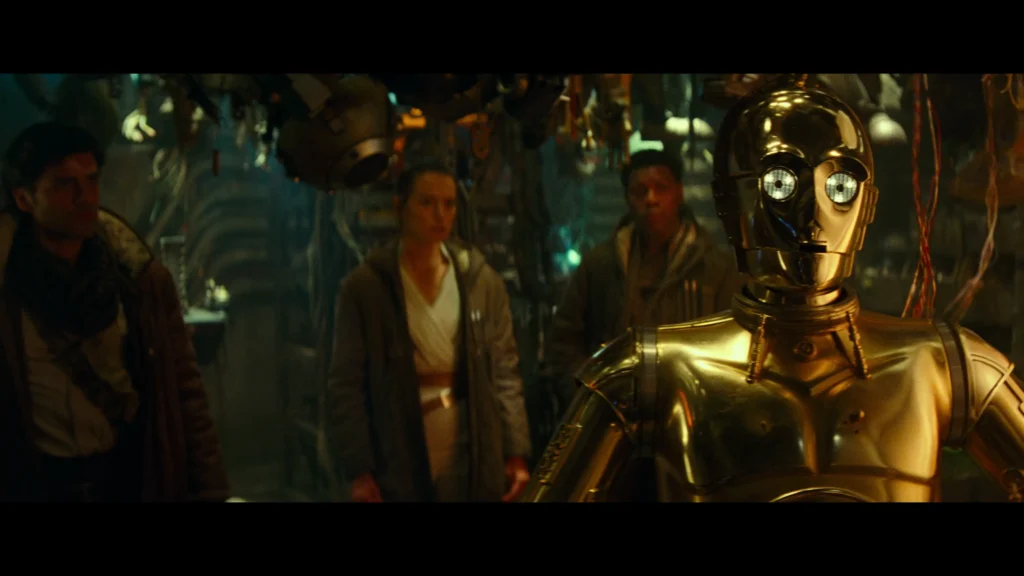
    That’s about all there is really. Morgan Elsbeth did nothing and went out like a chump. Every time a Jedi did a force push it looked utterly ridiculous. The David Tennant robot eventually did what he’d been threatening to do for seven episodes and became slightly grating to listen to. RIP Green Mary Elizabeth Winstead, she never looked good. They even ruined my theory that you couldn’t put an Andor actor into the same scene as an Ahsoka actor by having Mon Mothma turn up live for another of those interminable council scenes, with a special guest appearance from C3PO. I assure you that as a true blooded Star Wars fan I toasted the screen when he entered, in gratitude for getting to see the guy I already know.

    So to revise my statement from the end of the first of these essays I wrote about Ahsoka, it does seem that there is no Lazarine return for quality Star Wars after all. The sickness, yes, is that unto death.


    Previously:

    1. Obi-wan: Episode 1
    2. Obi-wan: Episode 2
    3. Obi-wan: Episode 3
    4. Obi-wan: Episode 4
    5. Obi-wan: Episode 5
    6. Obi-wan: Episode 6
    7. The Phantom Menace (video essay)
    8. Andor: Episodes 1, 2, 3
    9. “Can Andor save Star Wars from itself?” Andor: Episodes 4, 5, 6 (plus supplemental)
    10. Andor: Episode 7
    11. Andor: Episodes 8, 9, 10
    12. Andor: Episodes 11, 12
    13. Ahsoka: Episodes 1, 2
    14. Ahsoka: Episodes 3, 4, 5, 6
    15. Ahsoka: Episodes 7, 8

    If you like my writing, watch my new video essay The Fanatic, available now with a short companion essay kindly published by Blood Knife. If you’re after more text, please follow me on Medium or subscribe to my Letterboxd reviews.

  • Ahsoka (episodes 3, 4, 5, 6)

    Last time we picked up the tale of Ahsoka Tano, former cartoon.

    Hayden Christensen, star of Obi-wan, makes his on-screen return.

    Look I’m sorry — I really am — but I’m struggling to care about Ahsoka. Despite my initial optimism, born of a desire to come to any work of art without preconception, in a state of pure innocence, my interest just hasn’t sustained. Part of this blame can rightly be portioned out to the show itself, which in a call-back to the dire days of Obi-wan spent a good three and a half episodes spinning its wheels (the plus points of those first two episodes quickly passing out of memory), followed by a passable but slight subsequent two and a half following. Part of it must sit with me.

    The good then, in brief: Thrawn is a passable villain. He has been introduced far too late in the game, and yet we were never allowed to be unaware of him, muting the possibility of the other villains (and this show is stacked with them) taking the fore. The Lord of the Rings planet is novel and spooky, though the proto-Hobbits were laying it on a bit thick and the action scene where Sabine fought the space-Orcs was dry. The threat of additional space-Orcs is dryer still. And the laser sword fight between Ahsoka and Ray Stevenson was delightful — bizarre that it was in the same episode as the placid duel between Sabine (motivation: have her opponent hang around a bit) and Shin (motivation: have her opponent hang around a bit).

    The bad, well: Let’s consider.


    I’ve failed to mention of course the triumphant return of Hayden Christensen, who is apparently allowed to be in these things so long as he doesn’t hang around too much. His episode-long ‘A’-story in Ahsoka’s mind palace hits all the nostalgia notes for Episode II, and were I structuring these essays in a sensible and planned manner this would be a prime time to tackle that film and Christensen’s performance therein.

    Hint I have however, with my use of the television-land language of ‘‘A’-story’, at what is ultimately bothering me about Ahsoka more than anything. It’s television. This is the most crushingly unfair of complaints, but at the root it’s what is turning me off. Obi-wan was never sure whether it was a diced-up movie or a cinematic miniseries, but Ahsoka is teevee, capital-T Television, with the ‘A’-story and the ‘B’-story and the self-contained episode plot always in an uneasy truce with the grand plot arc, in a way TV writers think was finally solved by Buffy the Vampire Slayer but it really wasn’t. Thrawn gets mentioned all the time because it’s foreshadowing, not because I should be expecting him to appear onscreen. There’s filler episodes because TV needs filler episodes. Ahsoka is what it aims to be and what it aims to be just isn’t for me. The same was true (but more recognisable) in Mandolorian. I’d be better off picking off standalone exceptional episodes than trying to take my medicine weekly like I have been.

    To me, Star Wars is cinema — the grand image, the swelling score, the single most important story that has ever been told playing out on screen in front of you. There’s no room in my Star Wars for day-to-day trials and tribulations. There’s no room for forty minutes of Ahsoka training Sabine. When Sabine is finally reunited with her lost paramour Ezra (no relation), she seems… pleased. Andor fooled me into thinking that I could watch a Star Wars TV show by being not Star Wars and not being really a TV show. More fool me.

    The show recognises that akin to Vader in Rogue One, Genevieve O’Reilly’s Mon Mothma can only appear in the same room as the cast of Ahsoka as an image, a representation, a spectre.

    I have fairer complaints. Green Mary Elizabeth Winstead has graduated from pebble-in-your-shoe to millstone-around-your-neck in terms of frustrating characterisation. You fought a war, Green Mary Elizabeth Winstead! You should be able to compellingly navigate a bureaucracy! You should be able to put your own contact lenses in!

    The decision to cast a different actor for young Ahsoka in the scenes opposite Christensen is really baffling. Dawson as Ahsoka hasn’t exactly been stretched by the demands of the role, among other tasks spending the entire Episode 6 reclined in a chair, so giving the scene with all the emotions to an (admittedly talented) newbie puts in a weird distance between the main actor and the scenes.

    There’s some real bite in the images of fallen Clone Troopers here, which flow into the next episode’s guerilla Stormtroopers.

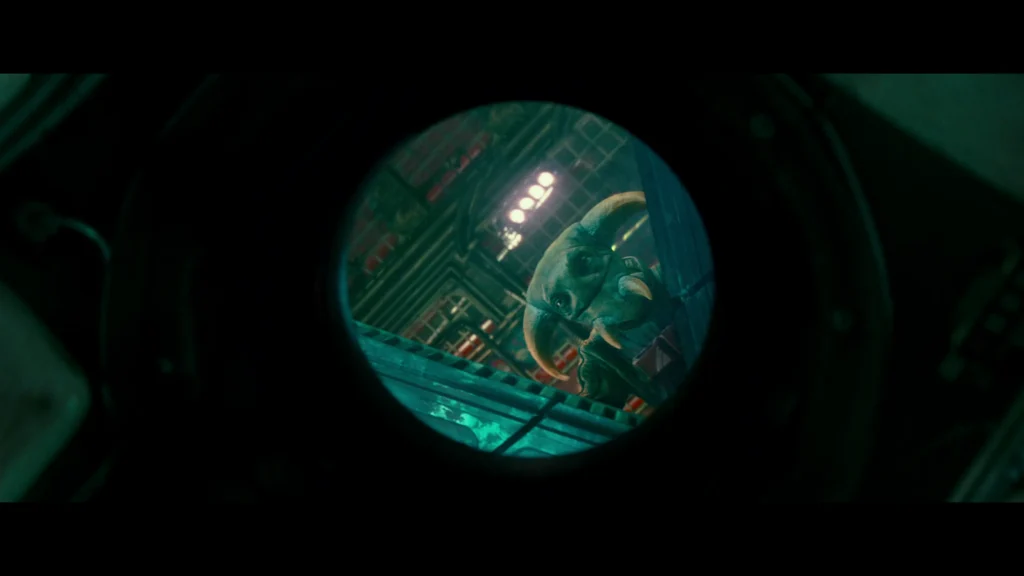
    The space whales are a particularly baffling piece of errata brought over from the cartoon. Structurally in the episode, interacting with them is the reward of the wisdom Ahsoka gains from confronting her personal demons and facing Anakin/Vader. Why facing down Vader permits you to talk to a whale is left by the show as an exercise for the viewer. It’s a nice visual though.


    I’m typing this out shortly before a new episode (7 of a total 8) is released. Perhaps it will sew this all together into one suitably grandiose narrative. Or perhaps it will cement my concern that this is all just marketing pre-roll for an upcoming return to movie theaters, with nothing of consequence being concluded: a final shot of a freed Thrawn vowing revenge on the galaxy, eight episodes to build what Rise of Skywalker achieved with a single Fortnite tie-in. Or perhaps it will be more jigsaw pieces settling themselves into the big patchwork board of Dave Filoni Star Wars TV shows, of interest to some (and very validly so, I should add) but maybe not, in the end, to me.

    George would have fixed this in post, that’s all I’m saying here.

    Previously:

    1. Obi-wan: Episode 1
    2. Obi-wan: Episode 2
    3. Obi-wan: Episode 3
    4. Obi-wan: Episode 4
    5. Obi-wan: Episode 5
    6. Obi-wan: Episode 6
    7. The Phantom Menace (video essay)
    8. Andor: Episodes 1, 2, 3
    9. “Can Andor save Star Wars from itself?” Andor: Episodes 4, 5, 6 (plus supplemental)
    10. Andor: Episode 7
    11. Andor: Episodes 8, 9, 10
    12. Andor: Episodes 11, 12
    13. Ahsoka: Episodes 1, 2
    14. Ahsoka: Episodes 3, 4, 5, 6

    If you like my writing, watch my new video essay The Fanatic, available now with a short companion essay kindly published by Blood Knife. If you’re after more text, please follow me on Medium or subscribe to my Letterboxd reviews.

  • Ahsoka (episodes 1 & 2)

    Way back last November I was talking about Andor and loose ends.

    The goofy headdress gives her something of Vader’s profile at a glance.

    It’s pathological at this point. I keep going back. Like every true Star Wars fan, all I want to talk about is this Star Wars that I don’t like (Obi-wan, you may recall). The signs were not promising here, as the next in a series of underwhelming Disney+ live action TV shows across all of their fetid intellectual properties, the trailer for Ahsoka made a baffling show of underwhelming face paint and robots fighting in a grey scrapyard. Regardless though, with the mood of a wayward child spitefully trekking upstairs to bed, I sat myself down and watched the first two episodes.

    It’s a continuation — I understand — of the cartoons, which are an element of Star Wars I deemed far too ‘expanded universe’ for my tastes circa 2003, and I’ve still only seen half of the Tartakovsky series, as well as a handful of Clone Wars episodes when it was briefly available on UK Netflix. I am aware though basic cultural osmosis that there is a character named ‘Ahsoka’, a female Jedi with two laser swords who was Anakin Skywalker’s apprentice before he had to go back to be in the regular movies*. Ahsoka is an interesting protagonist, being introduced in a Raiders-of-the-Lost-Ark-esque sequence where she breaks into a tomb, solves a puzzle, then emerges with the prize to find her enemies waiting. You’d be forgiven at first for thinking her a bit of a generic badass, but once she has to interact with the show’s secondary characters the character gains some fun dimensions: she’s awkward, a touch cold, very direct, and easy irritating. She’s not making any quips, is what’s important — an invaluable trait that keeps the whole thing from feeling utterly trivial.

    I was horrified in the opening scroll that this whole thing was going to be about tracking down this secret map-sphere, in the fashion of Force Awakens. Thankfully it is not.

    Secondary protagonist Sabine, Ahsoka’s own disappointing protege, is exactly the quip-primed badass who plays by no-one’s rules you might expect of a modern Star War. The first episode smartly undercuts this by immediately making Ahsoka completely correct in her narrow estimations of the character — once Ahsoka’s Padawan as she was Anakin’s — as Sabine loses the priceless magic map-apple that Ahsoka grave-robbed in the opening. Green Mary Elizabeth Winstead, who seems oddly underserved by the smirk-heavy acting direction in these first two episodes, is the Zordon-like figure nudging these plucky kids around and David Tennant plays a camp robot in the finest Star Wars tradition.

    Green Mary Elizabeth Winstead is about as far from Stellen Skarsgård as you can get, but they’re in similar roles.

    It’s pleasant, it should be noted, to be enjoying a Star Wars property fronted by a series of women. Leia and Padme were great characters but often perhaps a tad outnumbered. The only other prominent male characters in these first two episodes are gravel voiced non-Jedi Ray Stevenson, and the guy who played Taub in House M.D., seen here playing a Taub-like character who apparently gets arrested at the end just for being a useless tit. Ahsoka, Sabine, Green Mary Elizabeth Winstead, tertiary antagonist Shin, looming primary antagonist ‘Morgan Elsbeth’ (might want to check if there’s an even more witch-like name in the back), it’s a bold move for a series that famously had executives twisting themselves into knots over whether The Last Jedi’s Rose Tico was permitted to appear in another movie.


    It’s not Andor, of course, but it’d be weird if it was. This is Star Wars in the form of Star Wars, and there’s a pleasing charm to seeing the aesthetic elements that Andor turned to new ends played straight. Showrunner Filoni was deemed something of a designated heir to the setting by Lucas and by contrast to Obi-wan (and Solo, Force Awakens, Last Jedi) which seemed to fear the association of the prequels Filoni appears to have a grasp of what it all means, what it’s all supposed to convey. The New Republic here appears in the negative space left by the Empire it deposed, nerdy types in cosplay helmets standing in the formations previously held by Imperial Stormtroopers, or going back further Trade Federation Battle Droids. Antagonist Ray Stevenson and his apprentice are introduced in a delightful mash-up of the start of A Phantom Menace and A New Hope, announcing themselves as two Jedi and performing a daring jailbreak (full marks to the Captain in this sequence, who does a note-perfect impression of Picard at his most cavalier).

    Nerd alert. Someone has put a plastic bin on that R2 unit.

    Where Ahsoka fails to live up to Lucas’s sextet is only in the melodrama of it all — hopefully this will ramp up as the series goes on. Anakin’s troubles are all-encompassing, with the score swelling in the beautiful setting as he curses that he cannot love Padme. Luke’s longing to leave Tatoonine is inflamed as he stares at the double sunset. And so on. Ahsoka is ‘just’ TV, for its sins. Hopefully it can transcend. There’s more than enough in these first two episodes for me to keep watching, I think — the only other possibility is that this sickness for watching Star Wars is a sickness unto death.


    Oh god I’m back on a Star War. Previously:

    1. Obi-wan: Episode 1
    2. Obi-wan: Episode 2
    3. Obi-wan: Episode 3
    4. Obi-wan: Episode 4
    5. Obi-wan: Episode 5
    6. Obi-wan: Episode 6
    7. The Phantom Menace (video essay)
    8. Andor: Episodes 1, 2, 3
    9. “Can Andor save Star Wars from itself?” Andor: Episodes 4, 5, 6 (plus supplemental)
    10. Andor: Episode 7
    11. Andor: Episodes 8, 9, 10
    12. Andor: Episodes 11, 12
    13. Ahsoka: Episodes 1, 2

    If you like my writing, watch my new video essay The Fanatic, available now with a short companion essay kindly published by Blood Knife. If you’re after more text, please follow me on Medium or subscribe to my Letterboxd reviews.


    (*) Is it congruent with Revenge of the Sith to suggest that Anakin trained an apprentice? It’s certainly a decision in the characterisation — solely watching the films, you might be tempted to imagine Anakin a sheltered youth, too long kept tucked under the wing of his teacher and master. The thought that he had his own run at being the teacher, while obviously doomed in any portrayal of the character (“Join me, and together we can rule the galaxy as father and son!”), makes him a decidedly more social animal.

    At some point in the script this was a classic Star Wars de-hand and we have been robbed.
  • Mr Andor-son (Andor Episodes 11, 12)

    Last time I thought a lot about sentimentality as Andor escaped from space-prison.

    “Authority is brittle. Oppression is the mask of fear.”

    This is how Andor leaves us for now, and it’s in a typically idiosyncratic fashion. These final two episodes are more of a coda than a climax, as most if not all of the remaining tensions of the previous ten episodes are released and the main story is pared back to where it was nine episodes ago: Andor is leaving Ferrix and all his material attachments behind, to join the Rebellion with Luthen. Like Luke in A New Hope, Andor has been radicalised by the actions of the Empire and his personal loss, and is ready to give his life to the cause this bearded mystic represents — and so he does.


    Having watched (until now) the indicated groupings of Andor episodes in batches, I watched these two week-to-week, feeling like the serialisation of the show had finally broken banks and flooded. I’m not sure if that’s the case, if Andor is now more TV than film, but I still wish I’d watched these two together. Episode 11 is mostly moving the pieces into place to make Episode 12 happen, with the exception of Luthen’s high tech escape from the tractor beam, a small moment of traditional Star Wars cool that’s almost (but not quite) in danger of spoiling Andor’s low-stakes mood.

    Andor himself is mostly out of the way across the two episodes, listening to a beautiful rendition of Chapo Trap House on his space-iPod and getting trapped in a sticky white web by some aliens whose car he was trying to space-hijack. He has learned that his mother has died, though, and against advice heads back to Ferrix for the funeral. Diego Luna has had ten episodes in which to teach us the face Cassian Andor makes when he is in pain, and that effort pays off here.

    Like that.

    The big finale of these two episodes is the funeral riot on Ferrix, which proceeds in a true-to-life fashion from a mood of elevated tension, elite contempt, over-policing and flashpoint violence, before immediately becoming a mad dangerous crush. The Empire tactically loosened its grip on the people of Ferrix, and pays for it in all the accumulated retribution and resentment that are hurled back, alongside a pipe bomb. The industrial construction on the Death Star, glimpsed in a somewhat superfluous post-credit sequence, is mirrored here in the unsteady hands of a young man piecing together this improvised explosive, the explosion of which is another triumph in Andor of making small-scale action impactful and terrifying.

    Having assembled all our main characters here, instead of having them play off each other we simply see how they react to the chaos, with (by turns) Luthen being distressed by it, Cinta taking it as the cover for tactical violence, Imperials of all stripes making terrible mistakes and misjudgements — most notably the officer who sends a single man to take a spiral staircase bell tower, but also Dedra in particular is unprepared for a situation in which she has to self-preserve. Syril on the other hand, despite all his other wretched qualities, takes the opportunity to be a hero of sorts. Andor, who has been in this situation far too often lately, sticks to the plan. Mon Mothma is blissfully unaware of any of this.

    The marching band sequence that leads up to the funeral and speech, and disorder thereafter, is striking and beautiful, drawing on the shared culture of real-world mining communities and treating them with respect. In the heist episodes we saw how Empire’s power can be brought to bear to clear people from their historic land and exterminate their culture; here we see the action through which a culture can reassert itself back against Empire.

    Ferrix is very well-realised.

    In the final episode the show lurches to a halt whenever it has to cut back for the remaining Coruscant scenes, brief though they are — though Mon Mothma suggesting indirectly to the ISB that her husband might be the cause of all that missing cash is a typically smart story moment, and her daughter running a Mishima-esque traditionalism cult for her schoolmates is deeply funny.

    The other notable scene on Coruscant is also strong. Dedra having found herself exactly where the action isn’t in the fight against the rebellion is funny, follows the dog-eat-dog rules we have seen in force at the ISB already, and is neat foreshadowing for how badly her show of force is about to go. Dedra and Syril both came to Ferrix to conquer and leave it bruised. Best for your career prospects to stay in the Imperial centre and watch from afar.

    Time gives the ability for a character to blossom and Dedra’s villainy is stronger for having had the time over these episodes to first pull you in with her girl-boss rise to acclaim and then push you away again with the reality of the character’s underlying fascism. It’s true that great movies can establish a character with such depth in a handful of scenes — it’s also true that the worst ones try and fail. Andor has luxuriated in the time taken to flesh out these characters.

    Andor’s mother, too, benefits in this way. It would be rote for a character who we only saw passive in life to speak posthumously of revolt. It would be better to see her feel that first spark of rebellion, so that we know what motivated her to want to fight back. But in having the time allocated to a TV show, Andor can have us know Maarva first, know the aspects of her character, and have us realise along with her that she has always been in rebellion. And that she’d want her cremated remains in the form of a brick be used to take someone’s face off.


    The hotel’s faux-Imperial stylings have all been building up to this shot.

    I was pleased that the “Luthen wants Andor dead plot” was both not compromised on (he really did want him dead) but also not dwelled on, set up only for the crushing final scene in which Andor, like Kino just a few episodes ago, has nothing else. One way out. Through the rebellion, or death.

    The strand of plot between Vel and Cinta is thus left to lie, with a few scenes stressing how Vel’s pampered mores are clashing with Cinta’s fervour but not much else, save for a stunning shot of Vel running into the chaotic fog of the funeral uprising which in all honesty justifies their presence all by itself. It’s an odd loose end for a show that has otherwise avoided them at all costs though.


    Andor is over then, for now. I’ll be interested to see if it can remain this good in the wake of critical success — I’m certainly hoping so. Much of my writing about Star Wars over this year has been grappling with the idea of what ‘good Star Wars’ is or should be, and this season of Andor is the most compelling argument that it can exist at all.

    The fashion in which the series leaves off here is sufficient that it could lead into the (hacked, chopped up) events of Rogue One just fine. It’s always been enough to just place Andor in the company of characters in the nascent Rebellion and say “that’s how it happened”. So it comfortably allows a second season to succeed or fail on its own merits, unnecessary as a continuation of this story. Andor has, stray plots aside, come to a conclusion here.

    Me, waiting for more Andor.

    Andor being good has catastrophically unbalanced my ranking system so I’m going to abolish it.

    Chronologically, if you want to follow me on my Star Wars adventure:

    1. Obi-wan: Episode 1
    2. Obi-wan: Episode 2
    3. Obi-wan: Episode 3
    4. Obi-wan: Episode 4
    5. Obi-wan: Episode 5
    6. Obi-wan: Episode 6
    7. The Phantom Menace (video essay)
    8. Andor: Episodes 1, 2, 3
    9. “Can Andor save Star Wars from itself?” Andor: Episodes 4, 5, 6 (supplemental)
    10. Andor: Episode 7
    11. Andor: Episodes 8, 9, 10
    12. Andor: Episodes 11, 12

    If you like my writing, please subscribe to my Letterboxd reviews or watch Sixteen attempts to talk to you about ‘Suicide Squad’, available on Youtube now.