Tag: Timothy Zahn

  • Books 6

    Books? Care for some books, Madam? Can I interest you in a short review of a book? Yes I can!

    Clarissa Oakes – Patrick O’Brien

    As is often the case with these later Master and Commander books, O’Brien is going back over ground already trodden – in this case the difficulties presented by having even a single woman present in the all-male environ of the Royal Navy ship at sea. In this case though it’s a well-deserved barnstormer, the titular Oakes an excuse to lay out in exacting detail how discipline and good manners aboard slowly disintegrate

    The dénouement is slightly contrived, with Oakes letting slip some essential puzzle piece in a casual conversation to Stephen ‘James Bond at sea’ Maturin, but otherwise it’s still astonishing how much O’Brien is getting from what is now a very long-in-the-tooth setting. Also he still hates Australia.

    Case Study – Graeme Macrae Burnet

    A funny one this, presented in the infamous modernist framing story where the author is provided with a bundle of papers, these ones alternating between a biography of a fictional enfant terrible psychotherapist in the 60s and the macabre diary of one of his latter-day patients. I found the slightly trashy diary sections preferable to the more literary biography, which despite being humourous and well put together was a bit much like reading an actual biography of a psychotherapist, which I wouldn’t often do.
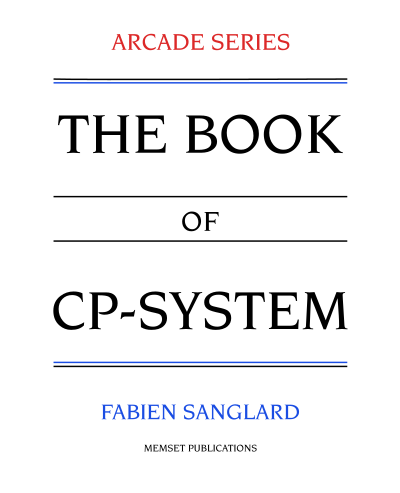
    The Book of CP-System – Fabien Sanglard

    Despite owning both Sanglard’s Game Engine Black Book: Wolfenstein and Game Engine Black Book: Doom, I wasn’t going to bother with this one as I have no particular connection to or affection for arcade machines; somehow however I got sucked into reading it during lunches at work. And it’s excellent, a detailed and fascinating breakdown of one of the great pieces of custom arcade hardware and what must have been involved in putting together games for it. I’d buy a physical copy but the price of Amazon’s print-on-demands is, uh, considerably more than I remember.

    Shadows of the Empire – Steve Perry

    Look, all respect to fan favourite character Dash Rendar but this is not a good book. Partial mark for the characterising Darth Vader as a sort of long-suffering Smithers to the Emperor’s Mr Burns, but everything else is tedious at best and gratuitously sexist at worse. I posted a round-up of some of the most Marenghi-like sentences.

    He Who Whispers – John Dickson Carr

    Back on the Dickson Carr, this one’s a real firecracker with each act taking place in an outlandishly gothic setup. There’s a central London dinner club no-one has turned up for, a man murdered alone atop a great stone tower, and sneaky goings-on in a New Forest stately home. Still sexist though.

    Inversions – Iain M. Banks

    I took the dive and read the last Banks Culture book I hadn’t covered. Turns out this was a great one to leave till last, knowing all the usual Culture series tics made spotting them from the outside in this inverse telling very satisfying. But the story stands as a fantastic bit of sci-fi all by itself, the story of nations – and by extension worlds – being given gentle nudges in the direction of what you might call progress by two different (but ultimately very similar) outsiders. Only flirts with the kind of ultra-violence that Banks tones down from this point on in the series, but was very prominent in e.g. Use of Weapons. It’s a slow burn in general, without much of the kind of action denouement Banks likes to give to the Culture novels. All the more memorable for it.

    The Long Shoe – Bob Mortimer

    Picked up this Bob Mortimer book at my Mum’s and read it over a weekend. Mortimer has such a distinctive patter that it can be distracting at first to read paragraphs written in his style, though he does occasionally throw it out and fill in a chapter or two from an outside perspective just to show he can. The plot is mostly nonsense, this is entirely about hanging out with the character sketches, so it’s a shame that some of them here are a little stale – ‘South London lifestyle yoga instructor’ is very mid-2000s – but I did enjoy it.
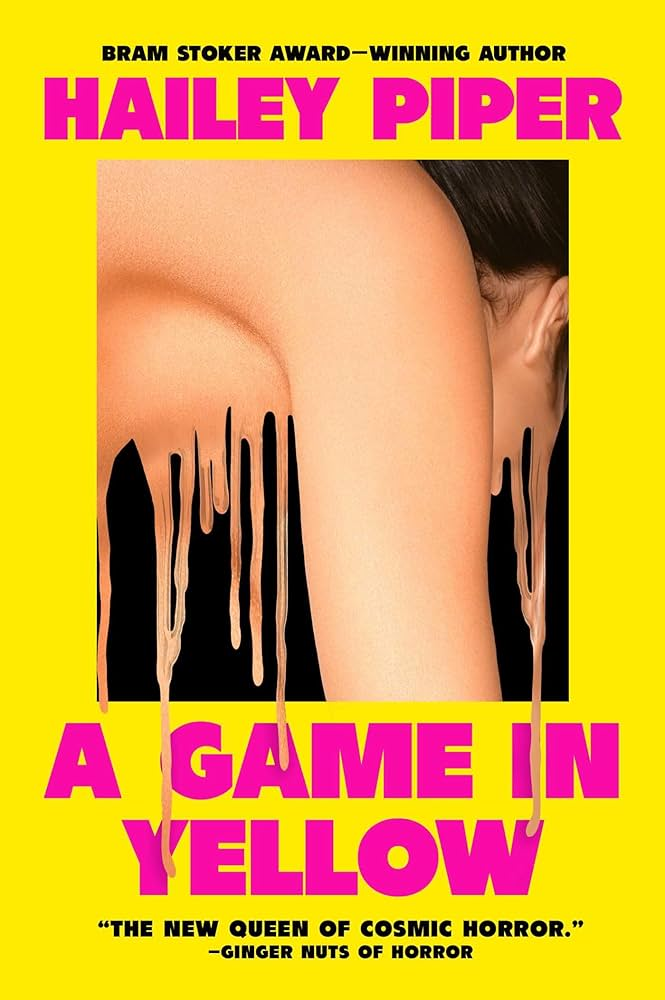
    A Game in Yellow – Hailey Piper

    I feel like I missed a lot of references and allusions here by not having read Chambers’ The King in Yellow. Having bought it entirely from seeing the cover in a bookshop window (I don’t read much horror), it was an enjoyable read on its own merits, a story of terminal self-sabotage with a strong noir flair. The depiction of BDSM is unusually authentic, almost to a fault. Like writing sex scenes as a whole, too much attention to detail can draw out the absurdity. That said, I’ve certainly read worse.

    Thrawn – Timothy Zahn

    I wasn’t expecting much from Thrawn 2.0 but Zahn really pulled out all the stops here, having been given the chance to start again and do Thrawn ‘right’ twenty five years after first writing the character. He turns in something which is actually kind of on the pulse of genre writing, with a handful of characters – Thrawn, his provincial attache Vanto and disinherited mining magnate Pryce – who are all in some way trying to serve an Empire that is inherently hostile to them. Shades of A Memory Called Empire or The Traitor Baru Cormorant, and Pryce’s story in particular is that kind of bureaucrat power play porn, culminating in her commiting an atrocity. The trick of the book is to get you to root for these bozos. It’s not Proust, it’s still a Star Wars book and it in fact directly ties in to a season of a children’s cartoon where Thrawn is a moustache-twirling characature, but I enjoyed this a lot more than I expected.

    Anathem – Neil Stephenson

    Scurrilous monks! I’d have been happy had they never left that monastery (or ‘concent’, as the book’s alien phraseology would have it) and they were just Name of the Rose-ing it up for 900 pages. In the event this was still a very wild ride, with the constant reconfiguration of setting and mystery meaning that the high page count flew past. It occasionally becomes a bit “Boy’s Own Adventure Weekly” with the regularity with which our motley protagonist Erasmus and crew are placed at the centre of attention, to the point where there’s an extremely jarring part where Erasmus returns to his formal rank within the order he’s part of and it just feels bizarre.

    It’s possibly the most end-of-history book ever written, albeit with a kind of strange optimism to it despite the deeply, utterly cynical account of human nature it presents. The philosophical and mathematical asides were fine, it’s something of a novelty to see phenomenology represented at all in literature, let alone as a positive development, so I appreciated that.

    Previously:
  • Books 4

    The joke is on you, the reader! I have only read more books since coming off parental leave!

    The Ionian Mission – Patrick O’Brien

    The Master & Commander books are well into a single continuous, roiling narrative at this point. A couple of classic-faire, tense boat-to-boat action scenes where O’Brien excels, and plenty of opportunities for the smiling boat-men of the Royal Navy to do boat-things described at length. There’s a particularly fun sequence where a large rope is tied up so a cannon can be lifted up a hill, which you wouldn’t believe is something that could be described as ‘particularly fun’. The handling of Ottoman politics and the depiction of the Ottomans we meet can be fairly easily described as ‘orientalist’ though, I fear.

    Heir to the Empire – Timothy Zahn

    [Kirk Voice] Zahn!!!

    After my experience with Splinter of the Mind’s Eye last time I was baited into reading the ‘Thrawn Trilogy’, which seem really to be the foundational texts of the Star Wars Expanded Universe. As a one-time reader of 90s Doctor Who novels which were very much happening in the margins of this sort of thing there was a warm familiarity to the slightly askew style of 90s sci-fi writing and Thrawn – the titular Heir – is but one of several fun additions to the Star Wars cast alongside the pleasantly distinct rogue-with-a-heart-of-gold Talon Karde and his first officer Mara Jade, who manages to escape the gravity well of her ridiculous backstory.

    Treason’s Harbour – Patrick O’Brien

    “It’s treason then.” Wait, wrong series. We’re back with the boats, and despite – as the review quoted on Wikipedia says – this being a book where nothing really happens, it remains a fun read. Maturin is engaged in carting a diving bell around, after his success in the previous book Aubrey is assigned more wildly unsuited political work, and surely one of fiction’s all-time least fired Chekov’s guns takes place as the interpreter assigned to the ship by the secret French agent takes a short bath in the Red Sea.

    Dark Force Rising – Timothy Zahn

    We can’t rule anything out when this book has a Grand Admiral in it. Well, maybe we can. Zahn (who by all accounts was hammering these out at the time) totally misfires and ends up writing the same book again but worse. The parts which do distinguish this one (Leia’s adventure on the planet of honourable assassins) are tedious in the extreme. Even the title gets in on being misconceived, with the ‘Dark Force’ in question being no relation to the mystic, luminous force the setting is primarily concerned with, but instead referring to the nickname for some missing robot starships.

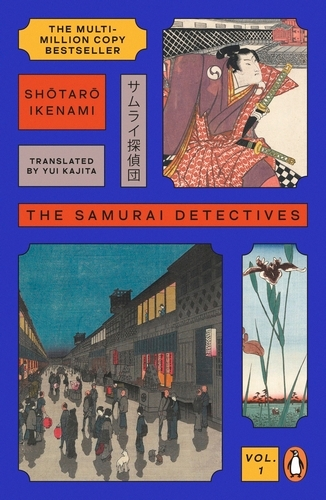
    Samurai Detectives Volume 1 – Shotaro Ikenami

    Bought this primarily on the strength of the cover, as with most books I buy. That’s my motto: strength of the cover. Despite being referred to as a ‘volume’ and being made up of nominal short stories there’s one continuous narrative that shifts back and forth between retired Samurai master Akiyama Kohei and his voluntarily celibate son Akiyama Daijiro. Set in the Edo period, there’s a fantastic realisation of what it would mean to travel and investigate in such a place. If only so much emphasis were not placed on Kohei’s, uh, passionate relationship with a woman forty years his younger.

    The Last Command – Timothy Zahn

    Zahn just about brings it home – not at all sure about the late-in-the-game decision to rework insane clone Jedi Master C’Boath into an Emperor-type (an heir… to the empire?!) just so the climax can be the throne room scene from Return of the Jedi, again, but this time Lando is also there for some reason. One of the problems Zahn has writing these is that his original characters end up being breaths of fresh air in the narrative because they’re not constantly thinking about or referring to the events of the movie trilogy. This means that Mara Jade’s bits are generally the best parts of the books and it’s annoying to have to go back to Luke fondly reminiscing about-

    Hey, nothing ever happened with that remote control Luke found on Dagobah!

    The Far Side of the World – Patrick O’Brien

    Hey, that’s the name of the film! A bit of a patchwork effort, this one, which concludes with the real whiplash of going from the intolerable sequence where Jack and Stephen are taken aboard a Pacific Islander boat which hates the penis to a 10/10 do-over of the climax of Desolation Island, wherein an outnumbered but technologically superior group of stranded Englishmen have to maintain a precarious peace on a desert island they share with a large group of nominally defeated American sailors.

    The Hollow Man – John Dickson Carr

    Bought this based on Daniel Craig flapping the book about on-screen in Wake Up Dead Man. It’s good fun, and Carr’s penchant for having a gaggle of detectives hang around operating in various different styles is distinctive, even if Chesterton-esque author insert Prof. Gideon Fell always takes primacy. Carr also has a strong line in making his witnesses useless or needlessly antagonistic, it’s something of a revelation the contrast to the usually pliable and cooperative characters you wind in murder mysteries – e.g. the killer in The Red Room would always answer questions even if he didn’t like to hear them.

    The Black Spectacles – John Dickson Carr

    I felt this was slightly less effective than The Hollow Man just because it increases the contrivances – in that book the mystery boils down to two bullets and two dead men, where here there’s two dead man, a poison pill, a movie camera, and that’s basically before things have got going. Slightly less enamoured with Fell’s theatrics here too. We get it Mr Fell, you think the killer is eeeeeevil. We know. Despite this, it is a meticulously constructed mystery and I was constantly kept guessing.

    The Reverse of the Medal – Patrick O’Brien

    “And then everyone stood up and clapped [for Jack Aubrey, unfairly placed in the pillory just for trying to do some insider trading].” I will note the bizarre manner in which O’Brien reminds the reader that Wray is a French trader, taking care to do it at the beginning of every book he features in after the decision to rework him from land-based duelling threat to craven Admiralty man. Feels like it would work just fine to have it be a surprise within each book where it’s relevant. Alas.
    I’m going to take a break from Master & Commander books after this one; not because I’m sick of them, but because the ones after this are an eye-watering £6.49 on Kindle. Outrageous.

    Death-watch – John Dickson Carr

    I was wondering why Dickson Carr isn’t more fondly remembered as a writer of murder mysteries; there’s a potential answer in Death-watch, which not only has the proclivity for complexity that was present in Hollow Man and Black Spectacles, but is also staggeringly misogynistic. At one point Fell, in full-on bloviating author stand-in mode, has a digression on why woman can’t be good barristers however intelligent they seem at university. Similar to Black Spectacles, there’s no final collapse of the contrivances here either, so while it’s satisfying how it all unfolds it’s difficult to hold the whole thing in your head to assess it.

    Previously: