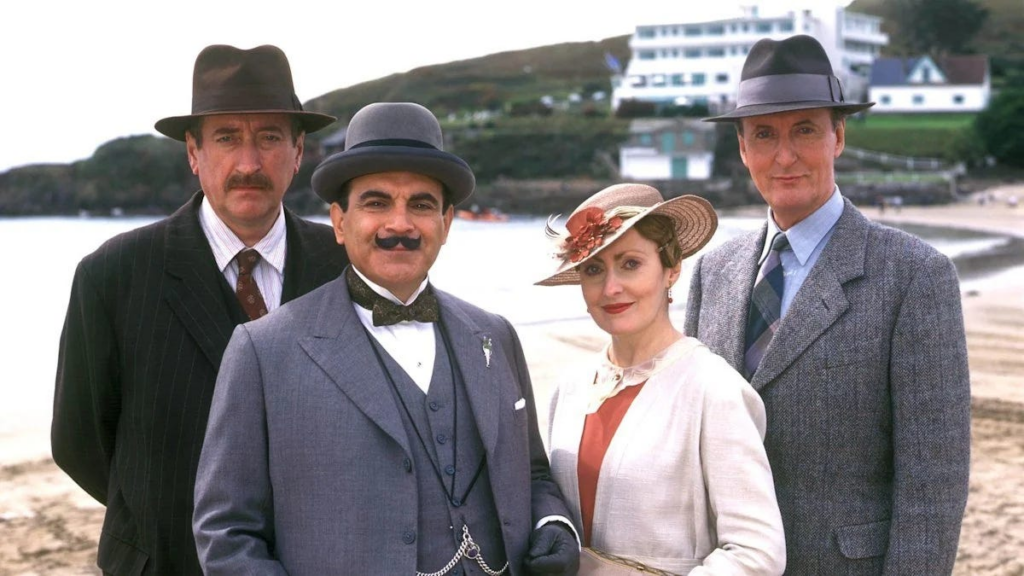
Netflix having cruelly torn from my grasp the miserable second season of Star Trek: The Next Generation, I’ve found myself at a loss for the low-key lunchtime (or teatime) entertainment you can only get from an early nineties TV show of utterly imposing length. Fortunately the streaming giant takes with the left hand but gives with the right, and in place of faintly cerebral sci-fi I’ve been granted stewardship of the complete Agatha Christie’s Poirot, a perplexingly good ITV show (ITV not being reknowned nowadays for quality drama, or quality anything really) which was produced starting in 1989 and ran all the way through to 2014, by which point it had apparently adapted every single Poirot story there exists to adapt.
Poirot himself is one of the great canonical fictional detectives, most famously taking the central role in Murder on the Orient Express. Portrayed here by David Suchet, he’s a diminutive but formidable Belgian with some considerable affection for Britain, fussy and exacting in his preferences, especially fashion. It’s a role that is given to camp, with both Peter Ustinov and Kenneth Branagh bringing out that quality first and foremost in their film adaptations. Suchet pulls the character back just the slightest bit, hewing closer to Albert Finney’s portrayal of the detective as a sharp, deliberative man who keeps his moustache in a little net at night.
The series is almost exclusively set in a suspiciously modern rendition of the late nineteen thirties, with ‘modern’ here used in the aesthetic sense. Poirot encounters a surely improbable number of groundbreaking works of architecture in the course of his investigations, with his own apartment an Art Deco tower block in Farrington which becomes a regular establishing shot. Christie’s novels are often concerned with the sun setting on the British Imperial aristocracy, that world of upstairs-downstairs class relations, endlessly suspicious overseas arrangements, and baffled naiveté about the realities of life. Making the encroachment of modernity into this world visual is the master-stroke of Agatha Christie’s Poirot and (to my memory) persists all the way through the show.
I’ve been watching episodes at random thus far, so in no particular order:
The Murder of Roger Ackroyd
One of the big guns for my first outing here, an adaptation of one of Christie’s most famous books full stop. The thing it’s most famous for is unfortunately a big twist, and despite my general antipathy towards worrying about spoilers that seems a mean way to lead into this set of reviews. Suffice to say that it’s a fine mystery, and rendered here with appropriately modern trimmings: Ackroyd is something of a modernist, and his butler proudly exclaims at one point that unlike many modernist buildings, Ackroyd’s house has been purposefully built to accommodate the movement of service staff. A central plot point hinges on Ackroyd’s possession of a dictaphone, as murder mystery plots are wont to do, and the device in question is a gorgeous old thing the size of a briefcase.
On the negative, there’s a second murder here which somewhat strains credulity in how it’s depicted here, in additional to being a little mean-spirited. Maybe in the book there’s a bit more of a motivation for it, here it seems chiefly designed to lend drama to an ad break.
Character Actor Watch
The titular Ackroyd in this – Malcolm Terris – is surely best known as the ‘WEAKLING SCUM’ guy from The Horns of Nimon. Dr Shepherd – Oliver Ford Davies – comes in a close second place as the alter ego of Naboo’s own Sio Bibble. I probably should care that there’s a brief appearance by Lee Adama from Battlestar Galactica, but I’ve never seen it so I don’t.
The Affair at Styles
Winding back the clock for this second watch, The Affair at Styles being something of a Poirot origin story, though not nearly so naff as that makes it sound. It takes place during the First World War, with Poirot a refugee from Belgium staying with another of other ex-patriots in a countryside cottage. Captain Hastings, recovering from some injury or other, calls on him to assist when the mother of his good friend is murdered and Poirot obliges – the two men know each other from some earlier drama on the continent. Also present is the obligatory Japp of Scotland Yard, who has also encountered the fearsome Belgian previously and his happy to let him roam free over his crime scene(s). It’s never quite clear, here or otherwise, why Japp of Scotland Yard apparently has jurisdiction over any given crime scene in any given location,
That oft-subtle theme of encroaching modernity is very literal here, with the antagonist literally a middle-class interloper in polite, aristocratic society, who talks, dresses and acts entirely without the casual charm of the other members of the cast. What is Poirot’s role here, an outsider to British culture who is nonetheless the very image of the polite gentleman and so often engaged to defend it?
Character Actor Watch
David Rintoul, playing Hasting’s good friend John Cavendish, made a brief but memorable appearance as the mad King Aerys in Game of Thrones. Better yet, the improbably round-faced Mr Inglethorp, Michael Cronin, played P.E. teacher ‘Bullet’ Baxter in seventy-odd episodes of Grange Hill.
The Mystery of the Spanish Chest
This one is an adaptation of a short story – as many of the first three series of Poirot will be. Adapted for screen it comes in at a standard commercial TV ~40 minute slot, making an hour with adverts. It’s an odd lurch after two feature-length stories to suddenly have the plot be really quite straightforward, with necessarily less of a focus on who did the murder in question (because there are so few characters that the who is immediately obvious) and more on how. The villain in question is the charmless Colonel Curtiss, who if you couldn’t deduce it otherwise says at one heinously racist thing in every scene. He’s come up with an extremely contrived method of seeing off the husband of the object of his affections, Marguerite Clayton, after which he will presumably sweep in and claim her for himself. It’s a very gruesome murder but not much of one for the ‘little grey cells’, to coin a phrase. What livens the episode up are some strong stylistic choices, even if they’re slightly wonky in execution: the episode opens with a flashback to a duel-to-first-blood, with both sabre-wielding gentlemen decked out in their finest early-20th century protective gear. Similarly, rather than having the fellow arrested, at the end of the episode Poirot rather illicitly unleashes the man who Curtiss tried to frame on him, and cowers in the corner as the two men duke it out. Both sequences are dream-like and absurd in a way that seems very unusual for the very grounded Belgian Detective.
Writer Watch
Anthony Horowitz pops up here for us, probably best known for his Alex Rider series of teen spy novels in the mid-2000s but also a prolific writer of adaptations and continuations of all sorts of thriller-esque settings – he’s done both Bond and Sherlock, for instance. He’s also one of those people who decide late in life to reveal themselves to have the political acumen of a small pebble, so there’s that.
Character Actor Watch
A young Pip Torrens stands out as Major Rich, the framed man, and the dead man is portrayed by Malcolm Sinclair – Colonel Yularen in Andor.
The Adventure of the Western Star
Our first all-round dud, sunk chiefly by the weak script which is constantly struggling to find a reason for all the relevant characters to be in anything like the same place at the same time. On top of that, two of the major players are doing absolutely abominable accents that wring out any pathos that may have been available to the roles. In what could be very charitably described as an homage to Sherlock Holmes, much of the episode is given to discussing a red herring plot involving a mysterious ‘Chinaman’ [sic] whose appearance presages jewel theft. Not nearly enough is done with this idea to justify its inclusion and it gets unceremoniously dropped anyhow.
A curiously passive role for our dear Inspector Japp of Scotland Yard in this one, where he spends the entire episode trying to collar a wealthy industrialist who he also suspects to be a gem thief – except he’s genuinely, if unpleasantly, trying to purchase the gemstone in question for money. Why is Japp after him for trying to buy a gemstone? Very strange. It all comes to a climax in a dramatic airport arrest scene where essentially nothing happens, though it was pleasing to see a depiction of London’s formerly premier airport, Croydon Aerodrome (long since superseded).
Character Actor Watch
Lady Yardly is played by a woefully underserved Caroline Goodall. The actor playing the awful Rolf, Oliver Cotton, was Cesare Borgia in the Borgias but much more importantly he was the stupid mask guy in the farmhouse militia mission in Hitman.
The Adventure of the Clapham Cook
Okay okay, it only took me five goes before I caved and went back to watch the very first one. It’s interesting to see how Suchet’s take on the role emerges pretty much fully-formed; over the course of the show he will become more cerebral and less clownish, but it’s immediately familiar – closer to the other episodes’ Poirots than Suchet’s interpretation of an early-career Poirot in The Affair at Styles, for instance. Both the scene where Poirot is infuriated by being sent a guinea for his efforts and the sequence of him dragging his perfectly polished little shoes through the countryside are impeccable bits of character work.
Everything else here is a bit more slack unfortunately, with a cast of broad-to-the-point-of-irritating troublemakers and some dodgy script work that leaves us with very little interaction with the ostensible villain. The climax centres on a question about ship destinations that gets introduced immediately before it becomes crucial, it just doesn’t work at all. It’s puzzling that the episode is entirely built on the idea that Poirot shouldn’t take on airs and ignore the less prestigious mysteries, but the Mrs Todd who dresses him down for that turns out to be exactly what she appeared to be: an annoying busybody. Strange. Oh, there’s also a bizarre pre-credits scene with the murderer that tells you nothing at all other than who’s going to have done it. Influenced by Columbo perhaps?
Character Actor Watch
Dermot Crowley who plays Simpson here was the rebel General Crix Madine in Return of the Jedi, best known for his truly awful facial hair. Danny Webb, who plays an irritating porter, is apparently in the new Game of Thrones show as Ser Pennytree. Slim pickings.
If you like my writing and want to read more, check out my (sadly truncated) 2025 Review of Film.